
Can Manure Replace Chemical Fertilizer? Honest Answer
Manure can replace much of your chemical fertilizer — but rarely all of it. The honest math on nutrients, bulk, timing, and the integrated middle path.
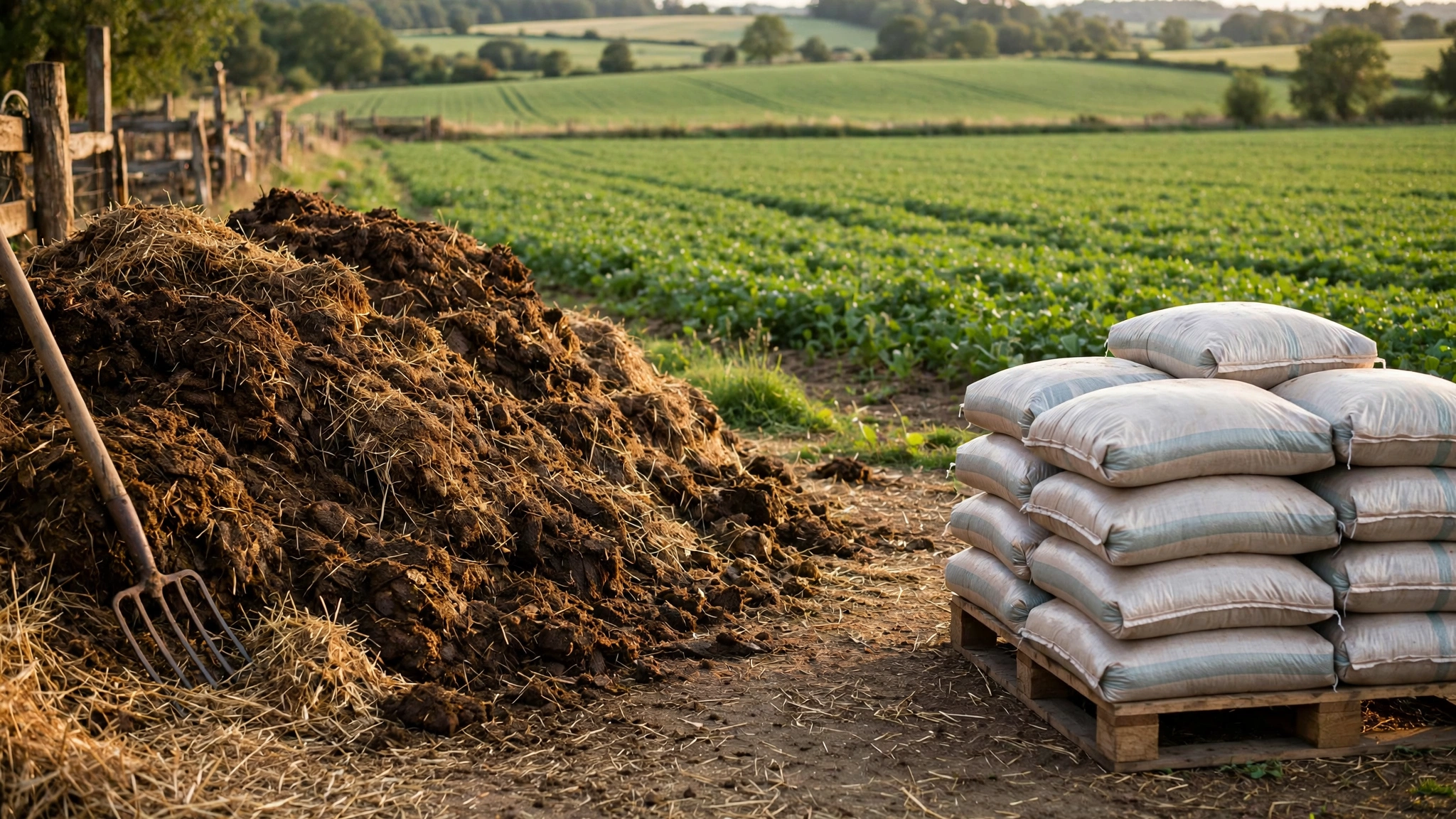
Can manure replace chemical fertilizer? The honest answer is: partially yes, fully rarely — manure can replace a large share of your chemical fertilizer and improve your soil while doing it, but matching the full nutrient demand of a high-yielding crop with manure alone takes enormous quantities that most farms cannot supply, transport, or time precisely. Think of manure as the foundation and chemical fertilizer as the precision top-up, not as enemies where you must choose one.
The concentration gap
Start with what manure actually contains. Farmyard manure and compost supply nitrogen, phosphorus, potassium, plus calcium, magnesium, sulfur, and micronutrients — a broader buffet than any single chemical fertilizer. But the concentrations are low and highly variable: a typical heap of well-rotted farmyard manure carries roughly a fraction of a percent to about one percent nitrogen, with phosphorus and potassium in the same modest range, and the exact numbers swing with the animal, its feed, the bedding, and how the heap was stored. One bag of urea holds as much nitrogen as a small truckload of manure.
That concentration gap is the whole debate in one fact. To supply 100 kg of nitrogen per hectare — a modest cereal dose — you might need on the order of ten to twenty tonnes of manure, against roughly 220 kg of urea. The manure also has to be loaded, transported, and spread: ten tonnes per hectare is real labor and real diesel. On a mixed farm where manure is already on site, this is manageable; buying and hauling it long distances quickly erases the savings.
Release speed and soil health
Release speed is the second fundamental difference. Chemical fertilizers dissolve and become plant-available within days, which is exactly what a crop needs at peak demand — tillering, flowering, grain filling. Manure's nutrients are locked in organic compounds that soil microbes must mineralize first, a process taking weeks to months depending on temperature and moisture. That slow release is wonderful for steady soil feeding and terrible for an emergency nitrogen top-up when the flag leaf is yellowing.
Where manure genuinely beats chemicals is soil health, and this is not a soft claim. Regular manure and compost additions raise soil organic matter, and organic matter improves structure, water retention, and the microbial life that cycles nutrients. Chemical fertilizers feed the plant; manure feeds the soil that feeds the plant. Fields receiving steady organic inputs typically handle drought stress better and need less corrective liming and micronutrient rescue over the years.
Quality, safety and precision limits
But manure quality is a lottery unless you manage it. Nitrogen escapes from open heaps as ammonia into the air — you can smell the loss — and rain leaches nutrients out of uncovered piles into the ground below, polluting without feeding any crop. Composting, meaning managed heaping with moisture and turning, stabilizes the nutrients, kills most weed seeds and pathogens through heat, and produces a far more uniform product. Fresh, uncomposted manure is the most problematic form: bulky, weedy, and unpredictable.
Food safety draws a hard line worth respecting. Fresh manure can carry pathogens, so it should never be applied close to harvest on vegetables eaten raw, and composting is the standard safeguard. Well-composted manure, heated properly, is a different and far safer material. This is one place where the 'natural is automatically safe' instinct fails — nature includes the pathogens too.
What manure cannot do is precision. A recommendation of 124-60-30 kg N-P2O5-K2O per hectare cannot be dialed in with a material whose own analysis you do not know and which varies heap to heap. Split nitrogen timing, starter phosphorus placement, potassium for grain filling — these are surgical jobs, and chemical fertilizers are the surgical tools. Expecting manure to do them is like expecting a good diet to set a broken bone: right philosophy, wrong tool.
Integrated nutrient management
The approach most agronomists actually recommend has an unglamorous name: integrated nutrient management. Use manure and compost as the base — as much good-quality material as you can reasonably source and spread — then soil-test, calculate the remaining nutrient gap, and fill exactly that gap with urea, DAP, and MOP. The result is typically a lower chemical bill, healthier soil, and yields that do not suffer. It is not a compromise; it is the professional standard.
Legumes deserve a mention as the middle path. Growing a legume — whether as a pulse crop or a green manure crop turned into the soil before the main season — fixes atmospheric nitrogen biologically, contributing meaningful nitrogen while adding organic matter. It does not replace phosphorus and potassium fertilization, but it can substantially cut the nitrogen bill. Combined with farmyard manure, it is the closest most farms get to low-chemical production without yield penalty.
Pitfalls, costs and a seasonal plan
Watch the hidden trap of heavy, repeated manure use: phosphorus buildup. Manure is relatively richer in phosphorus than in nitrogen compared to what crops remove, so fields manured heavily year after year often test excessively high in phosphorus — the same lockup and zinc-antagonism problems as over-applied DAP, arrived at by the organic route. Soil testing catches it; the fix is to cut back and let the crop draw the reserve down.
Cost comparisons need full accounting, not just bag prices. Manure looks free on a livestock farm until you count loading, transport, and spreading labor across tonnes per hectare; chemical fertilizer looks expensive until you count the yield protected by precise, timely nutrition. The cheapest system per kilogram of grain is usually the integrated one — moderate manure for soil health plus targeted chemicals — rather than either extreme.
A practical seasonal plan looks like this. After harvest, soil-test. Apply whatever good composted manure you have, ideally before the main tillage so it incorporates. When the test-based recommendation arrives, subtract a conservative credit for the manure's nutrients — conservative, because release is slow and variable — and buy chemical fertilizer only for the remaining gap, using our /calculator to convert the nutrient need into actual bags. Top-dress nitrogen with urea at the growth stages the crop demands. That is integrated nutrient management in one paragraph.
The mistakes to avoid are symmetrical. On one side: declaring the farm 'fully organic' on manure alone and watching yields sag for lack of timely nitrogen and phosphorus. On the other: dismissing manure as old-fashioned while the soil's organic matter slides downward year after year. Both extremes cost money; the middle path is where the evidence points.
So yes, manure can replace much of your chemical fertilizer — sometimes most of it — but do it with open eyes: compost it, count its nutrients conservatively, mind phosphorus buildup, and let precise chemical top-ups cover what bulk organics cannot. Run the remaining nutrient gap through our /calculator, study what each input contributes in the /fertilizers library, and check the /faq for practical questions on composting and application rates.