
Why Are My Plant Leaves Turning Yellow? A Nutrient Guide
Yellow leaves are your plant's distress signal. Learn to read the pattern — old vs new leaves, veins vs margins — to identify the exact nutrient deficiency.
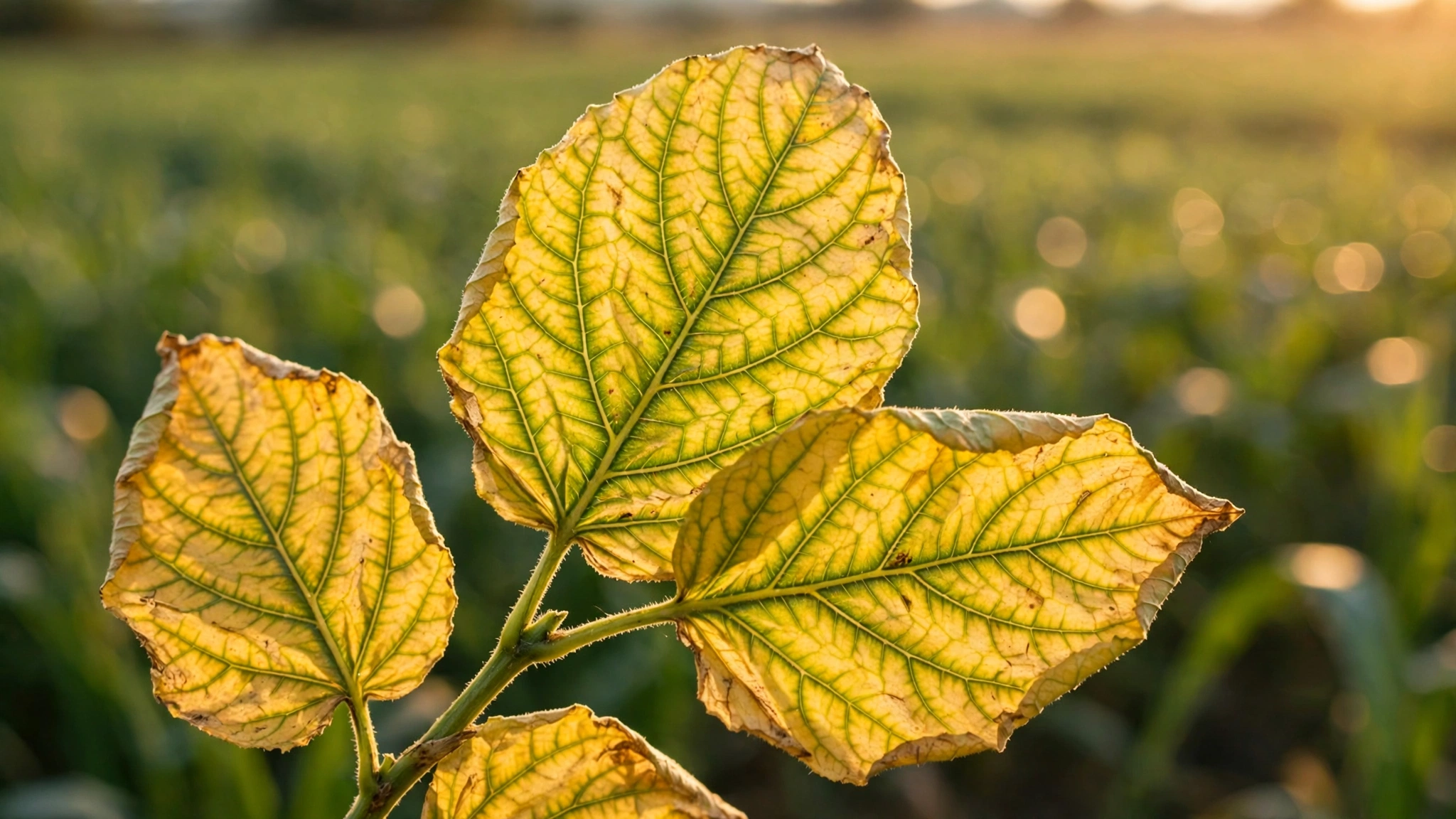
Why are my plant leaves turning yellow? The short answer is that yellow leaves are the plant's distress signal for a nutrient problem — most often nitrogen — but the pattern of the yellowing tells you which nutrient is actually missing. Leaves turning yellow because of nutrient deficiency follow rules: if the oldest, lowest leaves yellow first, the missing nutrient is a mobile one the plant is pulling out of old tissue to feed new growth; if the youngest leaves at the shoot tips yellow first, the missing nutrient is immobile and cannot be relocated.
Nitrogen: the most common cause
Nitrogen deficiency is the most common cause of yellowing, and it starts at the bottom. Nitrogen is highly mobile inside the plant, so when supply runs short, the plant strips nitrogen from its oldest leaves and sends it to the growing points. The result is a uniform pale-green to yellow color that begins at the leaf tips of the lower leaves and creeps inward, while the top of the plant still looks reasonably green. Growth slows, tillering drops in cereals, and the whole plant looks washed out. If your field shows this bottom-up yellowing a few weeks after sowing, nitrogen is suspect number one.
Iron, magnesium and sulfur clues
Iron deficiency looks completely different, and confusing the two is the classic mistake. Iron is immobile, so the youngest leaves suffer first: they turn yellow between the veins while the veins themselves stay green, a pattern called interveinal chlorosis. The older leaves stay green. This is extremely common in alkaline soils, where iron is present in the soil but locked into insoluble forms the roots cannot absorb — the plant is starving in a full pantry. If new leaves are yellow with green veins and your soil pH is above 7.5, think iron before nitrogen.
Magnesium deficiency also shows interveinal yellowing, but on the older leaves, because magnesium is mobile. Magnesium sits at the center of the chlorophyll molecule, so without it the leaf cannot stay green. The yellowing starts between the veins of lower leaves and the leaf edges sometimes take on a reddish or purplish tint. It is often seen in acidic, sandy soils where magnesium has leached away, and in crops with heavy potassium fertilization, because excess potassium competes with magnesium uptake.
Sulfur deficiency mimics nitrogen deficiency so closely that even experienced farmers mix them up — with one reliable difference. Sulfur is much less mobile than nitrogen, so the yellowing appears first on the younger leaves rather than the oldest ones. The whole young leaf turns a uniform pale yellow-green. With air pollution controls reducing atmospheric sulfur deposition over the years, sulfur deficiency has quietly become more common in many regions, especially in oilseeds and pulses that have a high sulfur demand.
Zinc, manganese and potassium signs
Manganese and zinc deficiencies produce their own signatures. Manganese deficiency shows as interveinal yellowing or grayish speckling on younger to middle leaves, sometimes with tiny dead spots. Zinc deficiency typically stunts the plant first — short internodes, small narrow leaves — with pale striping between the veins. In rice and maize, zinc deficiency after heavy phosphorus fertilization is a textbook case of nutrient antagonism: the problem looks like a zinc shortage, but the cause is a phosphorus excess blocking zinc uptake.
Potassium deficiency rarely starts as pure yellowing; it starts at the margins. The edges of older leaves turn yellow and then brown and crispy, as if scorched, while the center of the leaf stays green longer. Because potassium regulates water movement in the plant, deficient plants also wilt faster in heat. If you see marginal burn moving up from the lower leaves, potassium — not nitrogen — is the likely gap.
Rule out non-nutrient causes first
Before blaming nutrients at all, rule out the non-nutrient causes, because they are common and fertilizing them is money thrown away. Overwatering suffocates roots and produces uniform yellowing that looks exactly like nitrogen deficiency; the difference is soggy soil and a recent heavy irrigation or rain. Severely compacted soil, root damage from tillage, and pest or disease attack on roots all reduce nutrient uptake and mimic deficiencies. Always check water, drainage, and roots before reaching for a fertilizer bag.
Soil pH is the master key most farmers overlook. Every nutrient has a pH window where roots can absorb it, and most sit comfortably between 6.0 and 7.0. Push the pH much above 7.5 and iron, manganese, and zinc lock up; drop it below 5.5 and phosphorus, calcium, and magnesium become hard to get while aluminum toxicity appears. A field can test adequate in every nutrient and still show deficiencies if the pH is wrong — you do not have a nutrient shortage, you have a nutrient availability problem.
Here is a practical field diagnosis routine you can run in ten minutes. First, note which leaves are affected: oldest versus youngest. Second, note the pattern: uniform yellowing, yellowing between green veins, or browning at the margins. Third, recall recent history: heavy rain or irrigation, recent fertilizer applications, and the soil pH if you know it. Old-leaf uniform yellowing points to nitrogen; young-leaf interveinal chlorosis points to iron; old-leaf interveinal points to magnesium; marginal scorch points to potassium. Write down what you see before you decide.
Correct the specific shortage
Correcting the deficiency starts with confirming it, because the wrong correction wastes money and can create a new problem. For nitrogen, a top-dressing of urea matched to the crop's growth stage usually greens the field within a week or two — use the dose from your recommendation, not a guess. For iron in alkaline soils, soil-applied iron sulfate often gets locked up again quickly, so chelated iron as a foliar spray or through fertigation gives the fastest response while you work on the longer fix of adding organic matter and, where appropriate, elemental sulfur to nudge pH down. For magnesium, magnesium sulfate applied to the soil or as a foliar spray corrects it directly.
The single most expensive mistake is blanket fertilizing — throwing a bag of urea at every yellow field. If the real problem is iron lockout at high pH, the urea does nothing for the yellowing and the excess nitrogen can push soft, disease-prone growth. The second mistake is treating the symptom forever instead of the cause: spraying iron every season while ignoring the alkaline pH that keeps locking it up. Fix the soil condition once, and the recurring deficiency often disappears on its own.
When the diagnosis is genuinely uncertain, a soil test settles it. A basic test reports pH, organic matter, and available N, P, K, plus often zinc and iron — exactly the numbers behind most yellowing cases. For high-value crops, a leaf tissue analysis is even more precise: it tells you what the plant actually absorbed, not just what the soil contains. Keep the reports; comparing them across seasons shows whether your corrections are working or the problem is drifting.
Prevention beats correction every time. A balanced basal dose at sowing covers the immobile nutrients that are hard to fix later, split nitrogen applications keep the mobile supply steady through peak demand, and regular organic matter additions buffer pH and feed the microbes that unlock micronutrients. Crops grown on tested, balanced soil rarely surprise you with yellow leaves mid-season.
Yellow leaves are a message, not a mystery: read which leaves and what pattern, check water and pH before nutrients, confirm with a test when unsure, and correct the specific shortage instead of guessing. To put numbers on the correction, run your soil-test figures through our /calculator, look up what each nutrient actually does in the /fertilizers library, and check the /faq for quick answers on deficiency symptoms and fixes.