
NPK Fertilizer Calculation Formula (With Worked Example)
The one-line formula that turns any nutrient recommendation into exact kilograms of urea, DAP and MOP — with a full worked example and the three mistakes that waste money.
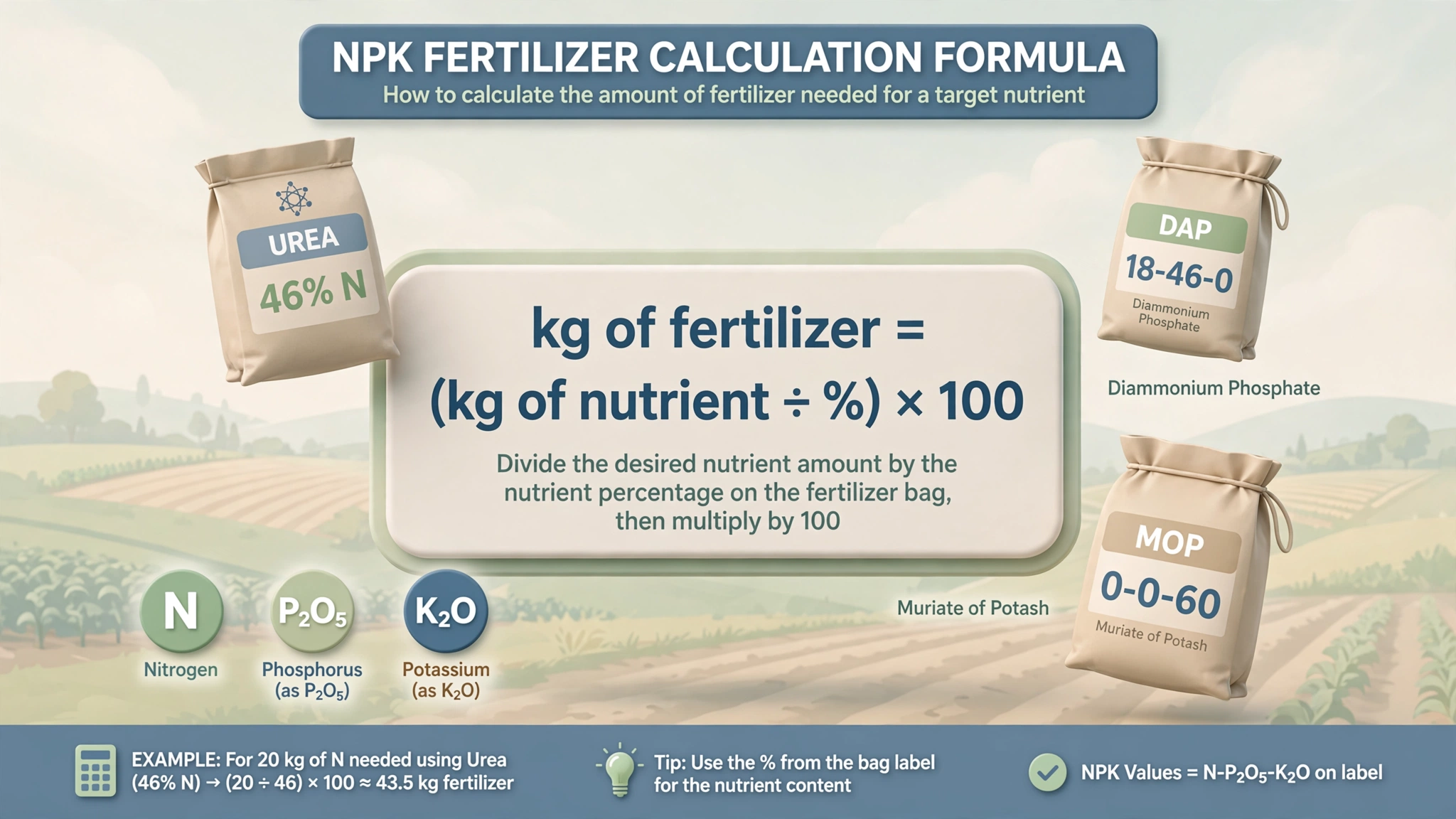
Your agriculture officer says 'apply 120 kg nitrogen per hectare' — but the shop sells urea in 50 kg bags. How many bags do you actually need? The answer comes from one simple formula: fertilizer needed (kg) = (nutrient needed in kg ÷ percentage of that nutrient in the fertilizer) × 100. For example, 120 kg of nitrogen ÷ 46 × 100 = 261 kg of urea per hectare, because urea contains 46% nitrogen. This guide walks you through the formula step by step, with a complete worked example using urea, DAP and MOP, and the common mistakes that cost farmers money.
The formula and the grades
The formula, plainly stated: every fertilizer bag carries three numbers, like 18-46-0 on DAP. These are percentages: nitrogen (N), phosphate (P₂O₅) and potash (K₂O), always in that order. The calculation is: kg of fertilizer = (kg of nutrient required ÷ % of that nutrient in the fertilizer) × 100. That is the entire formula. Everything else is just applying it carefully, one nutrient at a time.
Know your fertilizer grades before calculating. These are standard manufacturing grades, printed on every bag: urea 46-0-0 (46% nitrogen); DAP 18-46-0 (18% nitrogen, 46% phosphate); MOP 0-0-60 (60% potash); SSP 0-16-0 (16% phosphate); SOP 0-0-50 (50% potash). A bag labelled 18-46-0 therefore contains 18 kg of nitrogen and 46 kg of phosphate in every 100 kg. Keep this table handy — every calculation below uses it.
Worked example step by step
Worked example: a 120-60-40 recommendation. Suppose your recommendation is 120 kg N, 60 kg P₂O₅ and 40 kg K₂O per hectare. (We use round figures to keep the arithmetic clear — they are illustrative, not a real recommendation. For the verified, source-linked dose for your crop and region, use Fertilizer Dose's calculator.) We will satisfy it with DAP, urea and MOP.
Step 1 — Meet the phosphate need with DAP. Only DAP (among our three) contains phosphate: 60 ÷ 46 × 100 = 130.4 kg DAP per hectare.
Step 2 — Count the nitrogen that came free with the DAP. DAP is 18% nitrogen: 130.4 × 0.18 = 23.5 kg N. This is the step most people skip — and then they over-apply nitrogen.
Step 3 — Supply the remaining nitrogen with urea. Still needed: 120 − 23.5 = 96.5 kg N. Urea required: 96.5 ÷ 46 × 100 = 209.8 kg urea per hectare.
Step 4 — Supply potash with MOP. 40 ÷ 60 × 100 = 66.7 kg MOP per hectare.
Step 5 — Convert to per acre (divide by 2.471): about 52.8 kg DAP, 85.0 kg urea and 27.0 kg MOP per acre. In 50 kg bags, that is roughly 1 bag of DAP, 1.7 bags of urea and half a bag of MOP per acre. Always calculate in this order — phosphate first (fewest product choices), then nitrogen, then potash — so the 'free' nitrogen in DAP is accounted for before you buy urea.
The P2O5 trap and money-wasting mistakes
The P vs P₂O₅ trap: recommendations are written as P₂O₅ (phosphate), not elemental phosphorus (P). These are not the same thing: 1 kg of P equals about 2.29 kg of P₂O₅. The same applies to potassium: recommendations use K₂O, not elemental K (1 kg K ≈ 1.2 kg K₂O). Fertilizer grades are also labelled in the oxide form (P₂O₅, K₂O), so as long as you use the formula above with the bag's printed numbers, the units stay consistent. Trouble only starts if you mix a soil-test report given in elemental P with a recommendation in P₂O₅ — always check which form your numbers are in.
Three mistakes that waste money. First, ignoring the nitrogen inside DAP: farmers who calculate urea for the full nitrogen dose on top of DAP routinely over-apply nitrogen, which causes lodging (the crop falling over) and wastes money. Second, calculating per acre from a per-hectare figure without converting: a hectare is 2.471 acres, so applying a per-hectare bag count to each acre overdoses the field by nearly two and a half times. Third, rounding up 'for safety': fertilizer math rewards precision — rounding every product upward compounds into a real overdose. Round to the nearest kilogram, not the nearest bag, and split applications across growth stages instead of putting everything down at sowing.
Common calculation questions answered
How do I calculate urea needed for 100 kg of nitrogen? 100 ÷ 46 × 100 = 217.4 kg of urea. Urea is 46% nitrogen, so you always divide the nitrogen need by 46 and multiply by 100.
Which fertilizer do I calculate first? Start with the nutrient that has the fewest product options — usually phosphate (DAP or SSP) — then nitrogen, then potash. This way the nitrogen inside DAP is subtracted before you calculate urea.
Does this formula work for liquid fertilizers? The principle is the same, but liquids are sold by volume with density and concentration on the label. Convert volume to weight first using the product's stated density, then apply the formula.
Can I use this for a one-kanal plot? Yes. Calculate per acre first, then divide: one kanal is a quarter of an acre in Pakistan, so divide the per-acre figure by 4. For the full per-acre workflow around this formula, see our guide on calculating fertilizer dose per acre.
Bottom line: the NPK fertilizer calculation formula is one line — divide the nutrient need by the bag's percentage and multiply by 100 — applied in the right order: phosphate first, then nitrogen, then potash. Master it and no shopkeeper's arithmetic can mislead you; or let Fertilizer Dose's calculator apply it for your crop automatically.