
Foliar Spray vs Soil Application: Which Is Better?
Foliar spray vs soil application: soil feeding handles the bulk of a crop's NPK needs, while foliar sprays are best for quick correction of micronutrient deficiencies. Most crops need both, for different jobs.
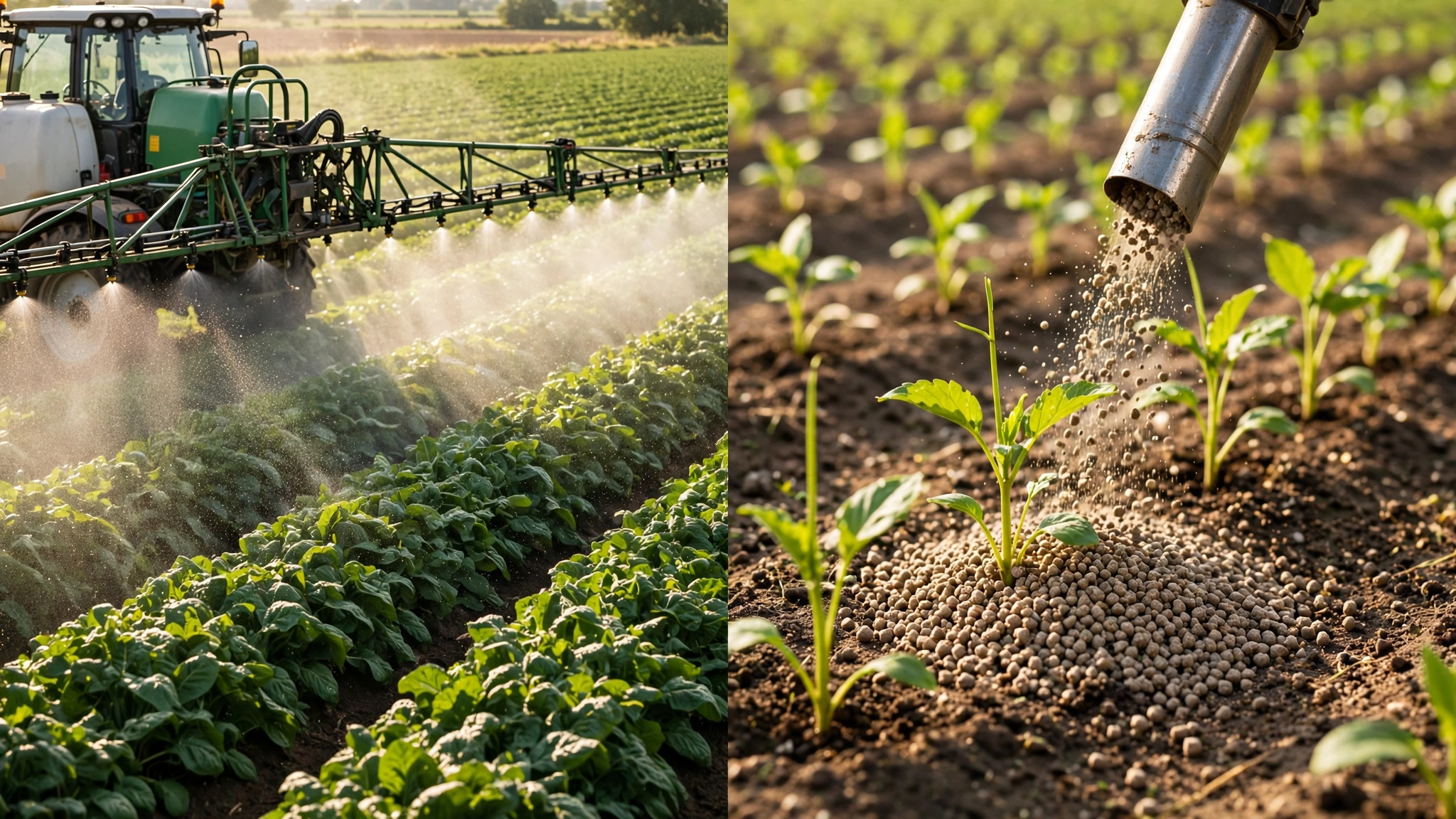
Foliar spray vs soil application: which is better? Neither wins outright, because they do different jobs. Soil application is how you supply the bulk of a crop's nitrogen, phosphorus, and potassium, the macronutrients needed in large amounts. Foliar spraying, where dissolved nutrients are sprayed directly onto the leaves, is best for quick correction of specific deficiencies, especially micronutrients like zinc, iron, boron, and manganese. Most well-managed crops use soil feeding as the foundation and foliar sprays as the targeted tool.
Soil application feeds the bulk needs
Soil application works through the roots, which are built for the job. Roots spread through a large volume of soil and absorb dissolved nutrients over weeks and months. When you place fertilizer in or on the soil, whether as a basal dose at planting or as top-dressing during growth, you are stocking the pantry the plant will draw from all season. There is simply no other practical way to deliver the tens or hundreds of kilograms per hectare that crops need.
Foliar feeding is fast but limited
Foliar feeding works through the leaves, which can absorb small amounts of dissolved nutrients through their surface. The advantage is speed: a nutrient sprayed on the leaf reaches the plant's system within hours, while soil-applied nutrients can take days to become available, especially in cold or dry soil. The disadvantage is capacity: leaves can only take in tiny quantities, and anything beyond that burns them.
This capacity limit is the key to the whole comparison. A wheat or rice crop might need over a hundred kilograms of nitrogen per hectare. You cannot deliver that through the leaves; the spray concentrations required would destroy the foliage many times over. But a zinc deficiency, which needs only a small amount of zinc to correct, is a perfect foliar job. Think of soil feeding as the main meals and foliar feeding as the vitamin tablet.
When and how to spray correctly
Foliar sprays shine brightest in a few specific situations. One is a visible micronutrient deficiency, such as yellowing between leaf veins, where a quick spray can green the crop up within days. Another is when soil conditions lock nutrients up: in very alkaline soils, for example, iron and zinc become unavailable to roots, but leaves can still absorb them from a spray. A third is during critical growth stages, like flowering, when a small targeted boost can support the crop at exactly the right moment.
Timing a foliar spray correctly is essential. Spray early in the morning or late in the evening, when temperatures are cool and the air is calm. The droplets need to stay wet on the leaf for a while so absorption can happen. Sprayed at midday, they dry in minutes, uptake stops, and the concentrated residue can scorch the leaf tissue. Never spray in strong wind either, because drift wastes product and can damage neighbouring crops.
Concentration is where most foliar mistakes happen. Always mix at the rate on the product label, and when in doubt, go weaker rather than stronger. Urea can be used as a foliar spray at low concentrations for a quick nitrogen touch-up, but the margin between helpful and harmful is narrow, and soil application remains the main route for nitrogen. A good habit is to test any new spray mix on a small patch and check the leaves the next day before treating the whole field.
Here is a sensible step-by-step for a foliar spray. First, confirm the deficiency or the need; do not spray on guesswork. Second, choose the right product and mix exactly to the label rate, using clean water. Third, check compatibility if you plan to mix with a pesticide, because some combinations react badly or lose effectiveness. Fourth, spray in the cool hours, covering the foliage evenly, including the undersides of leaves where absorption is often better. Fifth, watch the crop for a few days and note the response.
Soil application best practices
Soil application has its own best practices. Apply the basal dose of phosphorus and potassium at or before planting, since phosphorus barely moves in the soil and needs to be near the young roots. Split the nitrogen into two or three top-dressings timed to the crop's active growth stages. Work granular fertilizer into the soil or water it in after spreading, especially urea, which loses nitrogen to the air when left on a hot surface.
In practice, the two methods are usually combined rather than chosen between. A typical programme is soil-applied NPK for the foundation, decided with a proper dose calculation, plus one or two foliar sprays during the season for micronutrients or quick corrections. This is standard practice in many intensive vegetable and cereal systems: the soil does the heavy lifting, and the sprayer handles the fine-tuning.
Can foliar fertilizer replace soil application?
Can foliar fertilizer replace soil application? No, and this is one of the most expensive misunderstandings in crop nutrition. A cereal or vegetable crop needs tens to hundreds of kilograms of NPK per hectare over a season. Leaves can absorb only grams per spray pass; pushing spray concentrations high enough to deliver bulk nutrients would scorch the foliage many times over. Foliar fertilizer is a supplement and a correction tool, not a substitute. The soil dose, basal plus top-dressings, does the heavy lifting, and foliar sprays handle micronutrient corrections and well-timed boosts. Any programme that tries to replace soil application with sprays will starve the crop while looking busy.
Common mistakes to avoid
The common mistakes tell the story of what goes wrong. The biggest is trying to replace the basal soil dose with foliar sprays, which starves the crop while looking like action. Next is spraying at midday and burning the leaves. Then comes over-concentration, mixing incompatible products, and spraying dusty leaves, where a layer of dust blocks absorption. Each of these is avoidable with a little discipline.
Cost and effort also differ. Soil application is simple: spread, incorporate, irrigate. Foliar spraying needs a sprayer, clean water, careful mixing, calm weather, and labour for every pass. That is fine for a high-value correction, but it makes no sense as the routine way to deliver bulk nutrients. Match the method to the job and the economics follow.
So how do you decide quickly? If the need is large, routine, or seasonal, use the soil: basal doses, nitrogen top-dressing, phosphorus and potassium. If the need is small, urgent, or specific, use the leaf: a zinc or iron correction, a flowering-stage boost, a rescue treatment when roots cannot take up nutrients. When both apply, do both, each at the right time and rate.
Start with the foundation: calculate the right soil dose for your crop and area with the tool at /calculator, learn what each fertilizer grade actually supplies at /fertilizers, and browse /faq for practical questions on mixing, timing, and application methods. Get the soil feeding right first, and foliar sprays become the precise finishing tool they are meant to be.