
How Long Does Urea Last in Soil?
Urea converts to plant-available nitrogen within days, but how long that nitrogen actually stays usable depends on temperature, moisture, soil pH, and how you apply it. Here is the timeline in plain words.
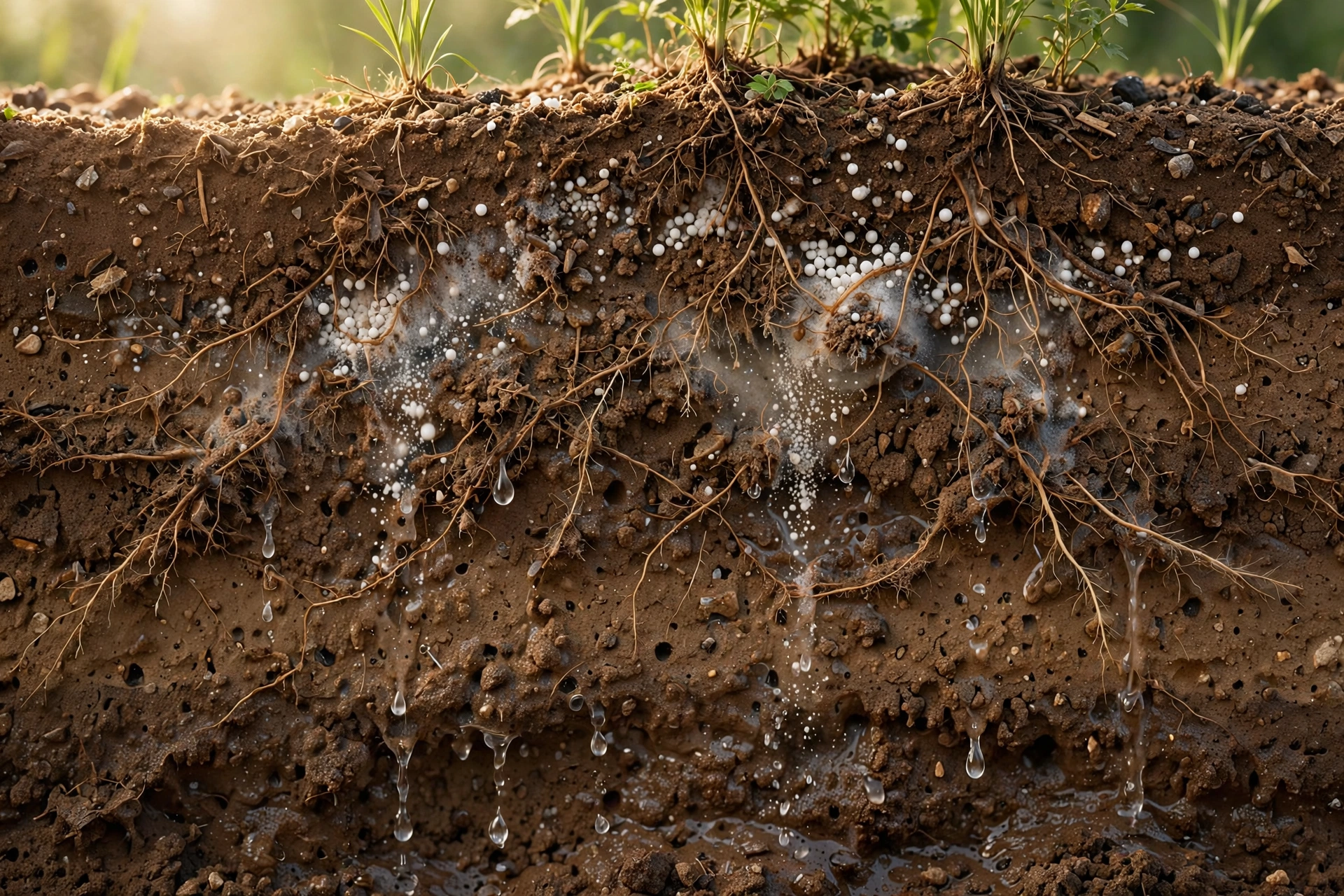
How long does urea last in soil? The short answer is that urea itself usually disappears within a few days, but the nitrogen it supplies typically remains available to crops for a few weeks — sometimes longer in cool conditions, sometimes much shorter in hot, dry, or sandy soils. Urea does not sit in the soil unchanged waiting for the plant. The moment it touches moist soil, a chain of transformations begins, and each step moves nitrogen into a form that is either easier for plants to use or easier to lose.
From urea to nitrate in two steps
Urea is the most concentrated solid nitrogen fertilizer in common use, carrying 46 percent nitrogen by weight. When a granule lands on moist soil, an enzyme called urease — which is naturally present in almost all soils — breaks the urea molecule down into ammonium. In warm, moist soil this first conversion is often complete within two to four days. That is why urea applied on the surface on a hot day can lose nitrogen to the air very quickly, while the same granule worked into the soil or washed in by irrigation stays put far longer.
Once urea has become ammonium, the story enters its second phase. Soil bacteria — mainly from two groups that nitrify in sequence — convert ammonium first into nitrite and then into nitrate. This nitrification process typically takes one to four weeks depending on conditions, and it is the step that matters most for availability, because most crops take up nitrogen fastest in the nitrate form. Ammonium is held on soil particles and moves little; nitrate is mobile in soil water, which means it flows toward roots easily but can also be washed below the root zone by heavy rain.
Why there is no single number
There is no single number for how long urea lasts because soil is a living system, not a warehouse. Warm soil speeds up every conversion step; cold soil slows them down, so nitrogen from a late-autumn application may persist in the ammonium form for many weeks while the same application in midsummer could be fully nitrified and leached within a fortnight. Moisture works the same way: microbial activity stalls in dry soil and races ahead in warm, damp soil. Soil texture and organic matter add their own influence, with heavier and richer soils holding ammonium longer than loose, sandy ones.
Three ways nitrogen escapes
The biggest way nitrogen leaves the system is through the air. When urea sits on the soil surface without being incorporated or watered in, some of the ammonium converts to ammonia gas and simply floats away — a process called volatilization. Losses are worst on alkaline soils, in hot and windy weather, and on fields with heavy crop residue on the surface. This is why agronomists consistently advise against broadcasting urea on the surface and leaving it there, especially in warm weather, and why a light irrigation or a timely rain right after application makes such a difference.
The second major escape route is downward. Nitrate carries a negative charge, so soil particles cannot hold it, and it moves freely with water. In sandy soils, or under heavy rainfall or over-irrigation, nitrate can be washed below the root zone within days of forming. This is leaching, and it is one of the main reasons nitrogen recommendations split the total dose into two or three applications instead of putting everything down at sowing. Each split feeds the crop during the growth stage that needs it most and reduces the amount sitting exposed in the soil at any one time.
A third pathway is denitrification, which happens in waterlogged, oxygen-poor soil. Under those conditions, other bacteria strip oxygen from nitrate and release nitrogen back into the air as harmless gas. Paddy fields, flooded patches, and poorly drained low spots lose nitrogen this way. It is a reminder that nitrogen management is not only about how much you apply but also about drainage and water management — nitrogen you cannot keep in the root zone is nitrogen you paid for and the crop never sees.
Stretching urea's useful life
In practical terms, what most farmers mean by how long urea lasts is how long the nitrogen keeps feeding the crop. Under typical warm-season conditions with the fertilizer incorporated or watered in, you can expect the nitrogen from one application to keep supplying the crop for roughly two to four weeks before most of it has been taken up, leached, or lost. That window is exactly why cereals like wheat and rice are usually fed nitrogen in splits — part at sowing or transplanting, and the rest as topdressing at tillering and flowering stages — rather than all at once.
Application method matters more than most people realize. Working urea into the top few centimeters of soil, or following a broadcast application with irrigation, can cut volatilization losses dramatically compared with leaving granules on the surface. On standing crops where incorporation is impossible, applying urea just before an irrigation or a forecast rain achieves the same wash-in effect. Deep placement of urea, where equipment allows, puts the nitrogen below the surface layer where ammonia escape is strongest.
There is also a class of products designed to slow the transformation chain: urease inhibitors delay the first conversion step, and nitrification inhibitors slow the ammonium-to-nitrate step, keeping nitrogen in the less mobile ammonium form for longer. These do not add nitrogen; they buy time. They can be worth considering in high-loss situations, such as surface applications in hot weather or on very sandy soils, but they do not replace good timing and incorporation.
Cold weather deserves a special note. In late winter or early spring, soil microbes work slowly, so urea converts and nitrifies at a reduced pace. That sounds like a benefit — nitrogen lingers longer — but it also means the crop may face a temporary shortage when growth starts, because the soil is not yet releasing nitrogen fast enough to meet demand. Timing applications to match the crop's growth flush, rather than the calendar, usually gives better results than applying early and hoping the nitrogen waits around.
Checking whether nitrogen is still there
How can you tell whether the nitrogen is still there? The most honest answer is that you cannot see nitrogen in soil, and guessing is expensive either way — too little costs yield, too much costs money and risks lodging and runoff. Soil testing before the season gives you a baseline, and tissue or leaf-color observations during the season tell you whether the crop is actually short. If your wheat or rice is pale despite an adequate basal dose, the missing nitrogen often went to the air or below the root zone, not into the plant.
One final practical point: urea is an excellent fertilizer precisely because it converts quickly and completely, not because it lasts long. Its job is to become ammonium and then nitrate on schedule. Trying to make one application stretch across the whole season fights the chemistry of the soil. Working with the natural timeline — incorporating each application, splitting the total dose across growth stages, and keeping water management tight — turns urea's short residence time from a weakness into an advantage, because you are feeding the crop when it is hungriest.
If you want to plan that timing precisely, start with the dose calculator at /calculator, which breaks your fertilizer into bags per acre or per hectare so you know exactly what each split costs. The crop pages under /crops show verified dose recommendations with their sources, /fertilizers explains what each product actually does in the soil, and the /faq answers common questions about mixing and applying. Getting the dose right matters, but as this article shows, getting the timing and placement right matters just as much.