What Happens If You Apply Too Much DAP?
Too much DAP wastes money and harms crops: excess phosphorus locks up in soil, can trigger zinc deficiency, and extra nitrogen risks seedling damage.
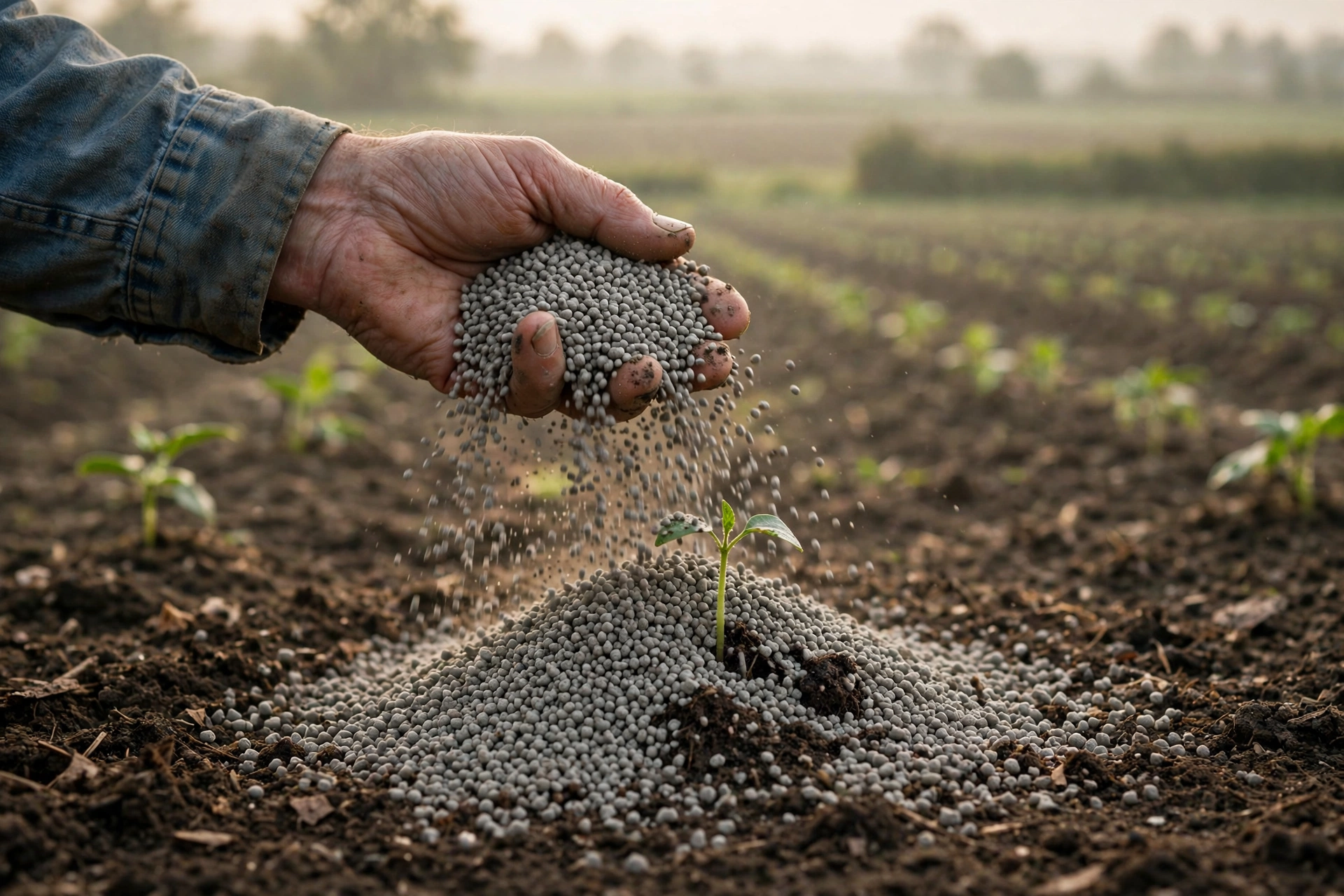
What happens if you apply too much DAP? The short, honest answer is that you waste money and can harm the crop, without gaining yield. DAP is 18-46-0, meaning 18 percent nitrogen and 46 percent phosphate, so an overdose hits the field with excess phosphorus and excess nitrogen at the same time, and each causes its own distinct problems. More fertilizer is not more food for the plant; past the recommended dose, it becomes a pollutant in your own soil.
Excess phosphorus locks up in soil
Start with the phosphorus half, because that is the larger number on the bag. Unlike nitrogen, phosphorus barely moves in soil. When you apply more phosphate than the crop can take up, the surplus does not wash away; it reacts with calcium, iron, and aluminum in the soil and converts into insoluble compounds the plant cannot access. Agronomists call this phosphorus fixation, and it means last year's excess DAP is mostly sitting in your field as locked-up reserves, not as available nutrition.
This immobility has a practical consequence: soil phosphorus levels ratchet upward year after year under repeated over-application, while the crop sees little benefit. A soil test will show high or very high phosphorus, and at that point the correct DAP dose for the next season may be small or even zero for a year. Farmers who soil-test regularly discover this and save the cost of bags they never needed; farmers who do not keep paying for phosphorus their soil already holds.
It blocks zinc and other micronutrients
Excess phosphorus also interferes with micronutrients, and zinc is the classic victim. High soil phosphorus is well known to induce or worsen zinc deficiency in crops like maize, rice, and wheat. The mechanism is a nutrient antagonism: abundant phosphate in the root zone suppresses the plant's zinc uptake, so leaves show zinc deficiency symptoms, pale striping between veins and stunted growth, even though the soil contains adequate zinc. The farmer sees a deficiency, but the cause is an excess.
Iron and manganese uptake can suffer in similar ways under very high phosphorus, particularly in alkaline soils where these micronutrients are already marginally available. The pattern is always the same: the field shows a deficiency that no amount of the deficient nutrient seems to fix, because the real problem is the phosphorus excess blocking it.
Nitrogen excess, seed damage, and runoff
Now the nitrogen half of the overdose. Every 100 kilograms of DAP carries 18 kilograms of nitrogen along with its 46 kilograms of phosphate. Apply double the needed DAP and you have also doubled a chunk of your nitrogen. Excess nitrogen pushes lush, soft vegetative growth that lodges easily in cereals, delays maturity, and invites pests and fungal diseases that thrive on dense, humid canopies.
In the seed furrow, excess DAP is directly dangerous to germination. DAP granules release ammonia as they dissolve, and concentrated ammonia near the seed damages the emerging root. This is the seedling burn described in our fertilizer burn guide: poor emergence, burnt root tips, and gaps in the stand. The standard safeguard is placement, banding DAP a few centimeters to the side of and below the seed, never mixed with it in the furrow.
There is also the environmental side, which matters even if it does not show in this season's yield. Phosphorus that leaves the field in eroded soil ends up in ditches, ponds, and rivers, where it feeds algal blooms that deplete oxygen and harm aquatic life. Nitrogen from the DAP's ammonium fraction can convert to nitrate and leach toward groundwater. Over-application turns your field into a source of pollution you are paying to create.
How much is too much
How much is too much? The honest answer is that it depends on your soil test, not on a fixed number. A field testing low in phosphorus genuinely needs a full DAP dose, perhaps around 130 kilograms per hectare to supply roughly 60 kilograms of phosphate, which is about two and a half 50 kilogram bags. That same dose on a field already testing high in phosphorus is too much. The bag count is only correct relative to what the soil lacks, which is why the dose always starts from a soil test.
A useful cross-check is the DAP-first method our /calculator uses. Because DAP supplies both nutrients, the calculator works out the DAP dose from the phosphorus need first, then calculates how much nitrogen that DAP already provides, and only then tops up the remaining nitrogen with urea. If you run your numbers through it and your usual DAP purchase comes out much higher than the calculated dose, that gap is the excess you have been applying.
Fixing an over-application
If you have already over-applied, the remedies are straightforward but slow. Do not try to flush phosphorus out with irrigation the way you would flush excess nitrogen salts; phosphorus does not leach, so heavy watering just wastes water. Instead, cut or skip DAP for the next season or two based on a fresh soil test, and let the crop draw down the accumulated reserves. For the nitrogen excess, deep watering can help move nitrate below the root zone, and splitting future nitrogen into smaller top-dressings prevents a repeat.
Watch for the zinc deficiency signal in the following season, especially in maize and rice. If interveinal chlorosis appears on a field with a history of heavy DAP use, consider a targeted zinc application rather than more DAP. Correcting the induced deficiency directly is cheaper and faster than waiting for the phosphorus excess to fade.
The common mistakes that lead here are all preventable. Applying DAP by habit every season without soil testing is the biggest one. Broadcasting extra DAP as insurance is another; phosphorus is not insurance, it is inventory that locks up. And mixing DAP with the seed to save a field pass trades a small labor saving for a real germination risk.
DAP is an excellent fertilizer when the dose matches the need: it delivers phosphate exactly where young roots can reach it and contributes useful starter nitrogen at the same time. The problems start only when the dose exceeds the need. Soil-test first, calculate the bags on /calculator, place it beside the seed rather than with it, and revisit the numbers on /faq whenever a new question comes up. Used that way, DAP builds yields; overused, it builds up problems.