
Does Rain Wash Away Fertilizer? What Actually Happens
Does rain wash away fertilizer? Light rain usually helps by moving nutrients into the soil, while heavy rain shortly after application can cause runoff and leaching. Here is what actually happens.
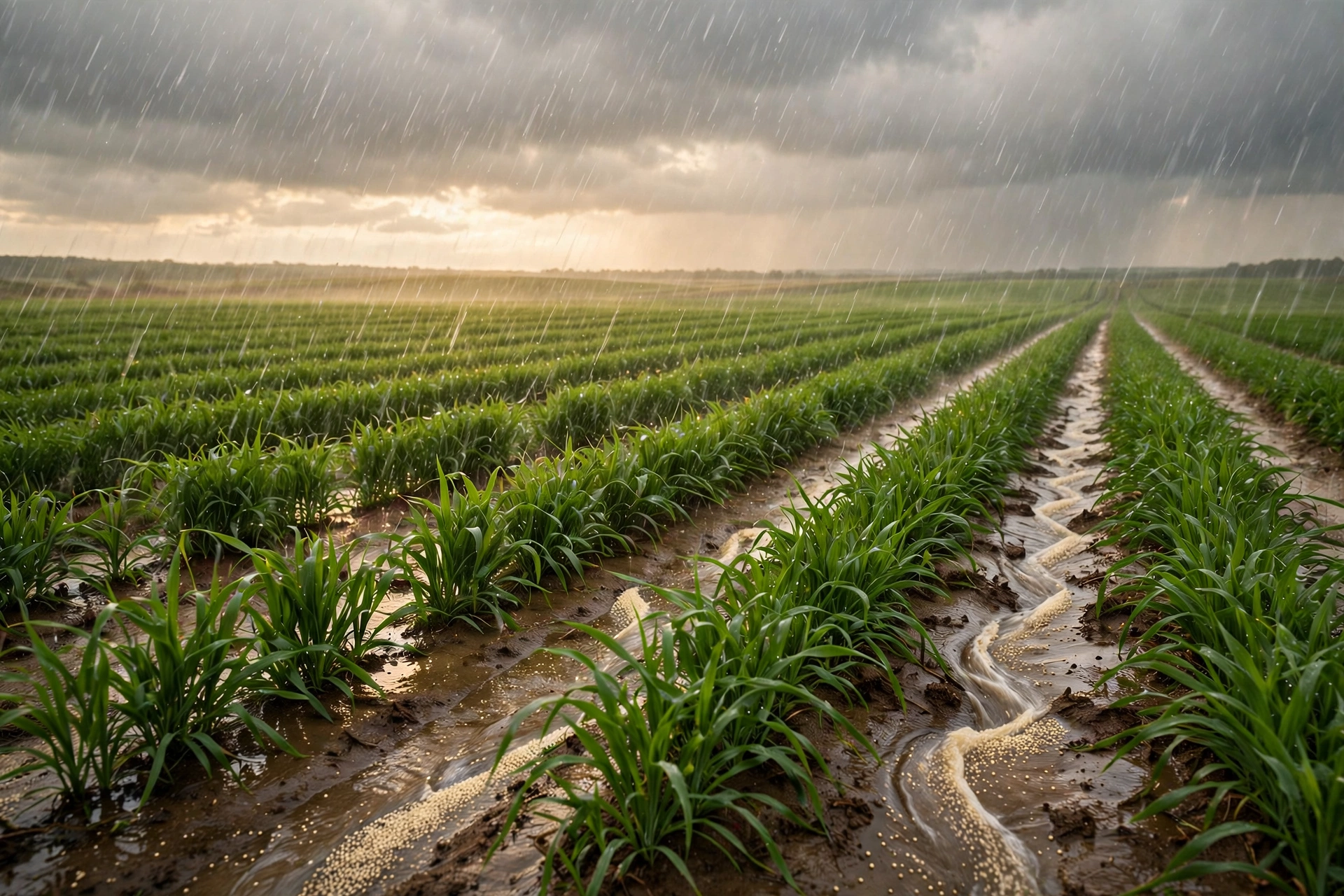
Does rain wash away fertilizer? The honest answer is: it depends on the rain. A light shower after you spread fertilizer is usually good news, because it dissolves the granules and carries the nutrients down into the root zone. A heavy downpour right after application is bad news, because it can wash granules off the surface and push dissolved nutrients below the reach of the roots. Timing, intensity, soil type, and slope decide which outcome you get.
Light rain helps, heavy rain hurts
Start with the good scenario. You spread granular fertilizer in the morning, and a gentle rain follows a few hours later. The granules dissolve, the nutrient solution moves a few centimetres into the soil, and the roots take it up over the coming days. In this case the rain did your incorporation work for you. Many farmers deliberately time their application just before a light, settled rain for exactly this reason.
Now the bad scenario. You spread fertilizer on bare, sloping ground, and a thunderstorm hits within the hour. Water sheets across the surface, carrying undissolved granules with it into low spots, ditches, and waterways. What is not carried sideways can be pushed straight down: in sandy soils especially, dissolved nitrogen can leach below the root zone, where the crop can no longer reach it. The fertilizer is not just wasted; it ends up where you do not want it.
How each nutrient moves in water
Different nutrients behave differently in water, and this is worth understanding. Nitrogen in nitrate form is very mobile and moves easily with water, which is why it leaches first. Phosphorus mostly binds to soil particles near the surface and moves very little, so it is lost mainly through surface runoff carrying soil with it, not through leaching. Potassium sits somewhere in between. This is why nitrogen management is the most sensitive to rain timing.
The timing of the rain relative to your application matters more than most people realise. Rain that arrives days after application, once granules have dissolved and nutrients have bound to the soil, causes far less loss than rain that arrives within minutes, while granules are still sitting exposed on the surface. The most dangerous window is the first few hours after spreading.
Soil type changes the picture completely. Sandy soils drain fast, so they leach nutrients quickly but rarely suffer surface runoff. Clay soils drain slowly, so they resist leaching but are prone to runoff when heavy rain cannot soak in. Slope makes everything worse: on flat ground even moderate rain mostly soaks in, while on a slope it runs off. Bare soil loses far more than soil covered by a growing crop or mulch, because roots and cover slow the water down.
There is a useful twist for urea users. Urea spread on the surface loses nitrogen to the air through volatilization, especially in warm weather. A light rain shortly after application actually reduces this loss by washing the urea into the soil, where it is protected. So with urea, a gentle rain is doubly helpful: it stops air losses and starts root feeding at the same time.
A routine for rainy seasons
Here is a practical routine for rainy seasons. Check the forecast before you spread and aim for a calm window of at least a day or two with no heavy rain expected. If light rain is forecast, that is fine, even ideal. Spread in the morning so granules have time to settle. On slopes, work the fertilizer lightly into the soil rather than leaving it on the surface. And keep a buffer strip near streams and ditches where you do not spread at all.
If an unexpected storm hits right after you applied, do not panic and do not immediately reapply the full dose. Wait and observe. If you can still see undissolved granules washed into piles or rills, some loss has occurred, but the dissolved portion in the soil is still there. Reapplying blindly risks over-fertilizing, which can burn roots and waste money. When in doubt, apply a smaller corrective dose later rather than a full dose now.
Split doses are the best insurance
Split applications are the best insurance in rainy climates. Instead of putting all the nitrogen on at once, divide it into two or three smaller doses across the season. If one dose is hit by bad weather, the others still feed the crop. This practice, called split application, is standard advice in high-rainfall regions, and it also matches the crop's needs better, since plants take up most nitrogen during active growth, not all at once.
The form of fertilizer matters too. Ordinary granular fertilizer dissolves quickly and is most exposed in the first hours. Slow-release and coated fertilizers release nutrients gradually, so a single storm washes away less. Liquid fertilizers sprayed on leaves are the most vulnerable of all to immediate rain, which is why foliar sprays should only go on when several dry hours are guaranteed.
Mistakes to avoid in wet weather
The most common mistakes are straightforward. Applying just before a forecast downpour is the biggest one. Spreading on waterlogged or frozen ground, where nothing can soak in, is another. Reapplying a full dose after rain without assessing what was lost leads to over-fertilization. And ignoring slope and soil type, treating a sandy hillside the same as flat clay, guarantees disappointment.
There is also an environmental side to this. Fertilizer that runs off into ponds, streams, and rivers feeds algae instead of crops, and that is a genuine pollution problem in many farming regions. Keeping to the right dose, keeping buffer strips near water, and avoiding application before heavy rain are not just good economics; they keep nutrients on your field and out of the water.
Rain is part of farming, not an enemy of it. The goal is to work with it: light rain as your incorporation partner, heavy rain as a signal to wait. Plan your applications around the forecast, split your nitrogen in wet seasons, and match the dose to the crop. The dose calculator at /calculator helps you get the amounts right, /fertilizers explains the products and their grades, and /faq answers common questions about timing and methods.