
What Is NPK 19-19-19 Used For? (Deep Guide)
NPK 19-19-19 is the all-rounder complex fertilizer: 19% each of N, P2O5 and K2O. Learn when it shines, when it wastes money, and how to dose it.
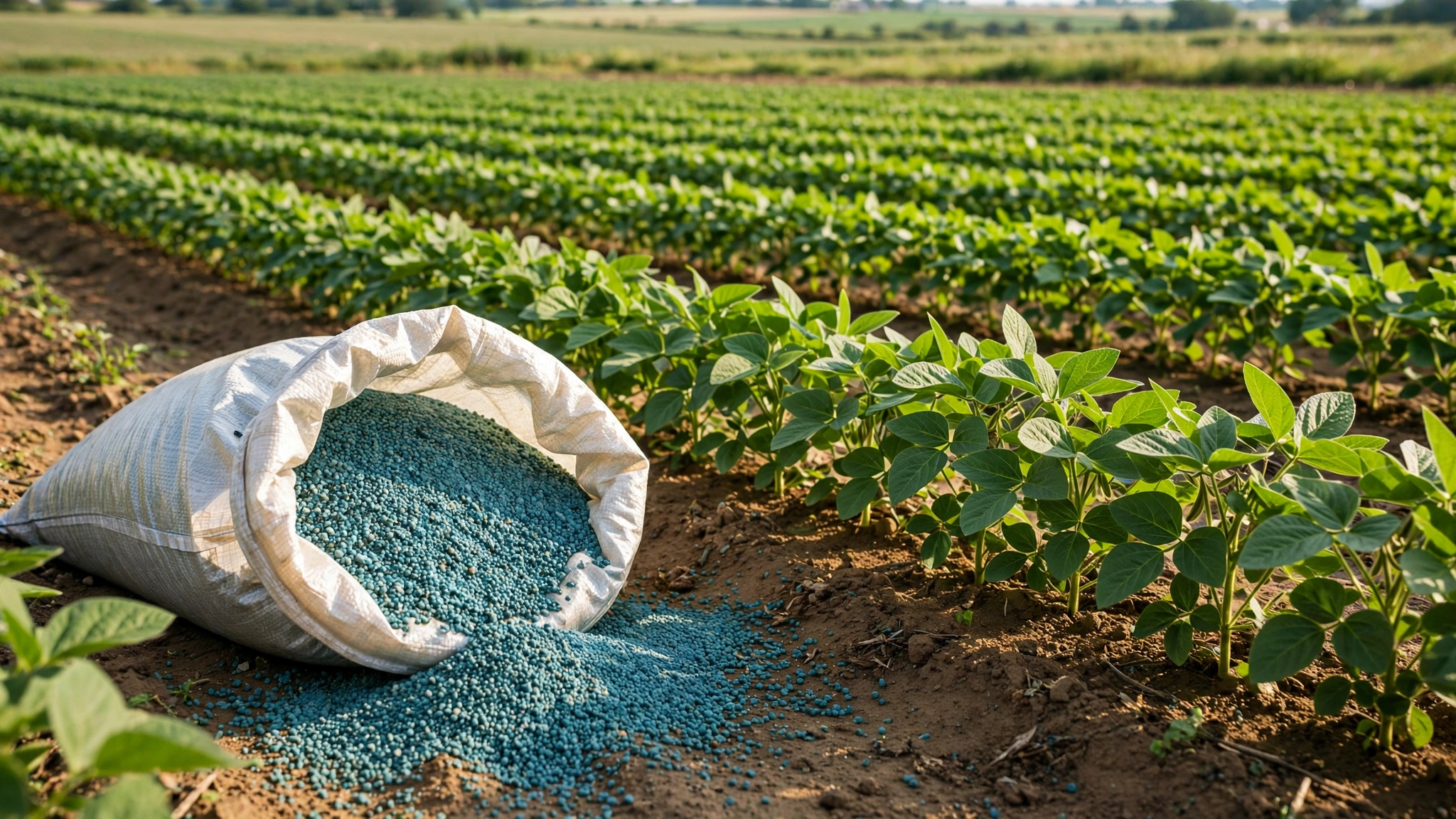
What is NPK 19-19-19 (sometimes written 19+19+19) used for? It is a balanced complex fertilizer used when a crop needs nitrogen, phosphorus, and potassium in roughly equal amounts — one bag that feeds the plant all three primary nutrients at once. The numbers mean 19 percent nitrogen (N), 19 percent phosphate (P2O5), and 19 percent potash (K2O) by weight, so every 100 kg of the fertilizer carries 19 kg of each nutrient, 57 kg of plant food in total. It is the general-purpose workhorse of the fertilizer world: vegetables, fruits, flowers, and field crops at planting time.
How to read the grade
To read the grade, remember the fixed order: the three numbers always stand for N, then P2O5, then K2O, always as percentages by weight. So 19-19-19 is 19% N, 19% P2O5, 19% K2O. The remaining 43% is carrier material that holds the granule together and helps it spread evenly — every fertilizer has it, and it is not a filler scam, just chemistry. Once you can read any grade this way, you can compare any two fertilizers on the only basis that matters: cost per kilogram of actual nutrient.
Complex versus straight fertilizers
The difference between a complex fertilizer like 19-19-19 and straight fertilizers like urea, DAP, and MOP is convenience versus precision. Urea is 46-0-0, DAP is 18-46-0, MOP is 0-0-60 — each supplies one or two nutrients, so you blend them to match an exact recommendation. With 19-19-19 you get all three in fixed proportion in a single application, which saves a mixing step and guarantees every granule that lands carries the same balanced ratio. Smallholders and kitchen gardeners love it for exactly this reason.
Best uses and dosing
Its most common uses are as a basal dose at sowing or transplanting, and in fertigation. As a basal, it is banded near the seed or seedling root zone so the young plant finds all three nutrients together as roots expand. In drip fertigation systems, the water-soluble grades of 19-19-19 dissolve completely and travel with the irrigation water straight to the root zone — this is where the fertilizer really shines, because fertigation demands fully soluble nutrients and uniform ratios, and 19-19-19 delivers both.
The dose math is the same formula agronomists use for every fertilizer: fertilizer required equals nutrient required times 100 divided by the nutrient percentage. Say your soil test calls for 60 kg of nitrogen per hectare. With 19-19-19: 60 times 100 divided by 19 equals about 316 kg per hectare. That single application simultaneously delivers roughly 60 kg of phosphate and 60 kg of potash, because the ratio is fixed. If your test instead calls for 60-30-30, 19-19-19 is the wrong tool — you would overshoot phosphorus and potassium chasing the nitrogen.
Limitations and cost
That fixed ratio is both the strength and the weakness of 19-19-19. It is perfect when the soil test shows a balanced need, but most real fields are not balanced. After years of DAP use, countless fields test high in phosphorus while still needing nitrogen and potassium — applying 19-19-19 there means paying for phosphate the soil already holds, and excess phosphorus can even induce zinc deficiency by blocking zinc uptake. The professional rule: match the fertilizer ratio to the soil test, not the other way around.
On cost, compare honestly per kilogram of nutrient, not per bag. Complex fertilizers typically cost more per unit of nutrient than urea, DAP, and MOP bought separately — you are paying for the blending, the uniform granule, and the convenience. For a large field with a precise 120-60-40 recommendation, the straight-fertilizer blend is usually cheaper. For a vegetable plot, a nursery, or a drip system where labor and uniformity matter more, the premium for 19-19-19 is often worth it.
Application, storage and mistakes
Application method matters as much as the grade. As a basal, place it in a band a few centimeters to the side of and below the seed — never mixed directly with seed in the furrow, where the salt concentration can injure germination. In fertigation, dissolve it fully and run it through the system per the manufacturer's guidance, flushing lines afterward. As a foliar spray, only the fully soluble grades at label-recommended concentrations; too strong a spray burns leaves, which is the most common misuse injury with this fertilizer.
Storage deserves a mention because 19-19-19 is hygroscopic — it pulls moisture from humid air, cakes into lumps, and loses its free-flowing granule. Keep bags sealed, off damp floors, and use opened bags promptly. Caked fertilizer still contains its nutrients, but it spreads unevenly, and uneven spreading means uneven feeding, which defeats the purpose of a uniform complex.
The classic mistakes with 19-19-19 are all versions of one error: using it by habit instead of by soil test. Farmers who apply it every season without testing often build phosphorus to excessive levels while underfeeding nitrogen at peak demand, because a balanced bag cannot supply the heavy, split nitrogen top-dressings cereals need — that job belongs to urea. Another mistake is assuming 'balanced' means 'ideal for everything': a fruiting crop hungry for potassium or a legume needing little nitrogen will both be served better by a ratio matched to the need.
The 19-19-19 grade belongs to a whole family of complexes — 20-20-20, 15-15-15, 12-32-16, 10-26-26, and others — each tuned to a different situation. High-phosphorus starters like 12-32-16 suit root establishment at planting; high-potassium grades suit fruiting and grain filling. Learning to read the grade, which our first blog in this series covers, lets you pick the right family member instead of defaulting to 19-19-19 for every job.
One more honest note: no bag, balanced or not, fixes bad timing or bad placement. Fertilizer buried too deep, applied weeks late, or broadcast onto dry soil without incorporation loses much of its value to fixation, volatilization, or runoff. The grade gets the credit, but placement and timing do half the work — a truth that holds for 19-19-19 exactly as it does for urea and DAP.
So: 19-19-19 is the convenient all-rounder for balanced needs, basal application, and fertigation — powerful when matched to a soil test, wasteful when used blindly. Check your soil test first, do the dose math with our /calculator, compare grades and nutrient roles in the /fertilizers library, and browse the /faq if you are choosing between a complex and a straight-fertilizer blend.