Organic Fertilizers for Plants: Compost, Manure and Vermicompost
FYM, compost, vermicompost and green manure — what they realistically contribute, how to use them, and an honest comparison with chemical fertilizers.
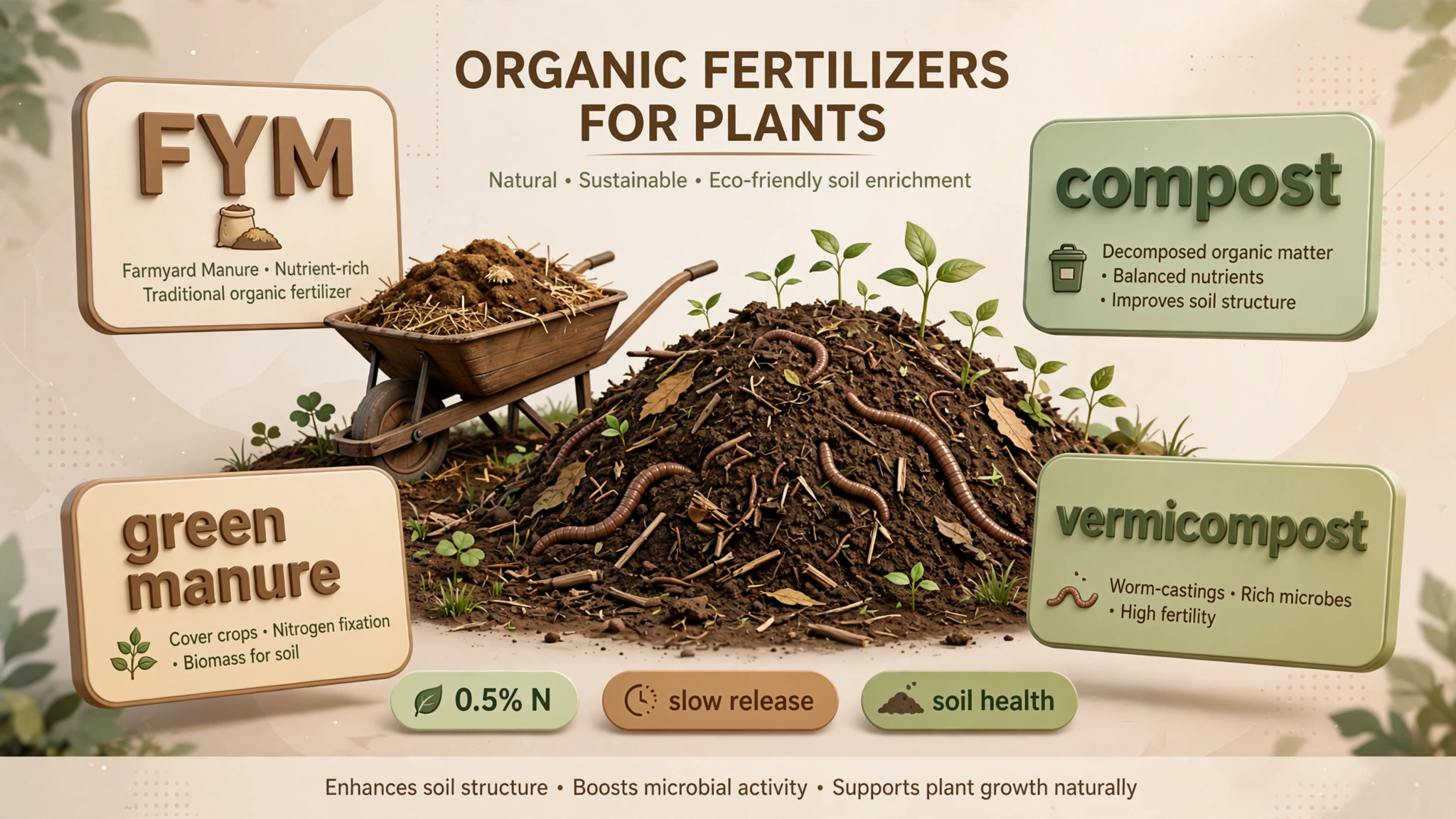
Organic fertilizers feed plants slowly by feeding the soil first. Unlike a bag of urea that delivers 46% nitrogen immediately, materials like farmyard manure, compost and vermicompost release nutrients gradually as microbes break them down — typically over weeks to months. As a rough orientation, well-rotted farmyard manure (FYM) contains about 0.5–1.0% nitrogen, 0.15–0.20% phosphate (P₂O₅) and 0.5–0.6% potash (K₂O) (FAO glossary of fertilizers and soil fertility terms). Compare that with urea's 46% nitrogen and the trade-off is clear: organics are bulky and slow, but they build soil structure that chemicals alone cannot.
About farmyard manure
Farmyard manure (FYM) — decomposed dung and urine of farm animals mixed with bedding — is the oldest fertilizer in South Asian farming. In finished, well-rotted material the carbon-to-nitrogen ratio typically settles around 15:1 to 20:1 — one sign the manure is mature enough to use safely. Indian agricultural teaching material (TNAU e-courses) cites an average of about 0.5% N, 0.25% P₂O₅ and 0.5% K₂O.
Two practical consequences follow. First, the quantities are large: supplying even 25 kg of nitrogen needs roughly 3–5 tonnes of FYM. Second, not all of it is available at once — extension literature notes only about 30% of the nitrogen (though 60–70% of phosphorus and ~70% of potassium) is available to the first crop, the rest releasing in later seasons. Apply FYM 2–3 weeks before sowing and mix it into the soil; fresh dung can harm seedlings and carry weed seeds, so always use well-rotted material.
Compost and vermicompost
Compost is decomposed plant and kitchen waste — leaves, crop residue, vegetable peels — broken down aerobically. Its nutrient content is similar to or slightly lower than FYM and varies with the feedstock, but its real value is humus: it loosens clay soils, helps sandy soils hold water, and feeds earthworms. For home gardens and potted plants, a 3–5 cm layer worked into the topsoil before planting is the standard practice. Like FYM, treat published nutrient figures as rough averages; the UK agriculture body AHDB stresses that manure nutrient content 'may vary significantly' with livestock type, diet and storage, and recommends analysing a sample for serious planning.
Vermicompost — organic waste digested by earthworms — is generally richer and more uniform than ordinary compost, with nutrients in more plant-available forms and beneficial microbes included. It is the gentlest option for seedlings and potted plants because it rarely burns roots. Because quality varies enormously between producers, buy from a reputable source and treat label claims cautiously; there is no single standard grade the way urea is always 46% N.
How green manuring works
Green manuring means growing a fast crop (often dhaincha, sunnhemp or berseem in Pakistan and India) and ploughing it into the soil before it seeds. Leguminous green manures add nitrogen fixed from the air along with organic matter. It costs a few weeks of field time but no purchased input — the classic low-cash route to better soil.
Organic versus chemical compared
Organic vs chemical: an honest comparison. Nutrient concentration: very low in organics (~0.5% N) versus very high in chemicals (46% N in urea). Speed: slow release over months versus immediate. Soil structure: organics build it, chemicals do not. Precision: rough and batch-variable versus exact printed grades. Quantity needed: tonnes versus kilograms. Neither is 'better' in absolute terms. The evidence-based approach is integrated nutrient management: use organics for soil health and baseline fertility, then top up precise nutrient needs with chemical fertilizers calculated for the crop. Reducing chemical doses blindly without accounting for what the manure actually supplies is a common mistake — if anything, get the manure tested and count its contribution.
Frequently asked questions
Can I grow vegetables using only organic fertilizer? Yes, especially in home gardens — but you need bulk quantities (several tonnes per acre equivalent) and patience, since nutrients release slowly. For heavy-feeding field crops, most farmers combine organics with some chemical fertilizer.
Is fresh cow dung usable directly? No. Fresh dung is high in ammonia and weed seeds and can burn young plants. Compost or rot it for several weeks until it is dark, crumbly and earthy-smelling.
How is vermicompost different from ordinary compost? Earthworm digestion makes nutrients more available and the product more uniform, and it usually contains beneficial microbes. It costs more per kilogram, so gardeners typically reserve it for pots, seedlings and high-value plants.
Do organic fertilizers change soil pH? Well-rotted organics have a mild buffering effect and generally nudge very acidic or alkaline soils toward neutral over time — but they are not a substitute for proper soil amendments where pH is severely off.
Bottom line: organic fertilizers trade precision for soil-building — slow, bulky and variable, but unmatched for soil structure and biology. Use them for baseline fertility, get the manure tested if you want to count its contribution, and top up the exact shortfall with chemical fertilizers — Fertilizer Dose's calculator works out the top-up for your crop and region.