
How to Calculate Fertilizer Dose Per Acre (With a Worked Example)
The exact formula agronomists use to convert a nutrient recommendation into bags of urea, DAP and MOP — explained with a real wheat example.
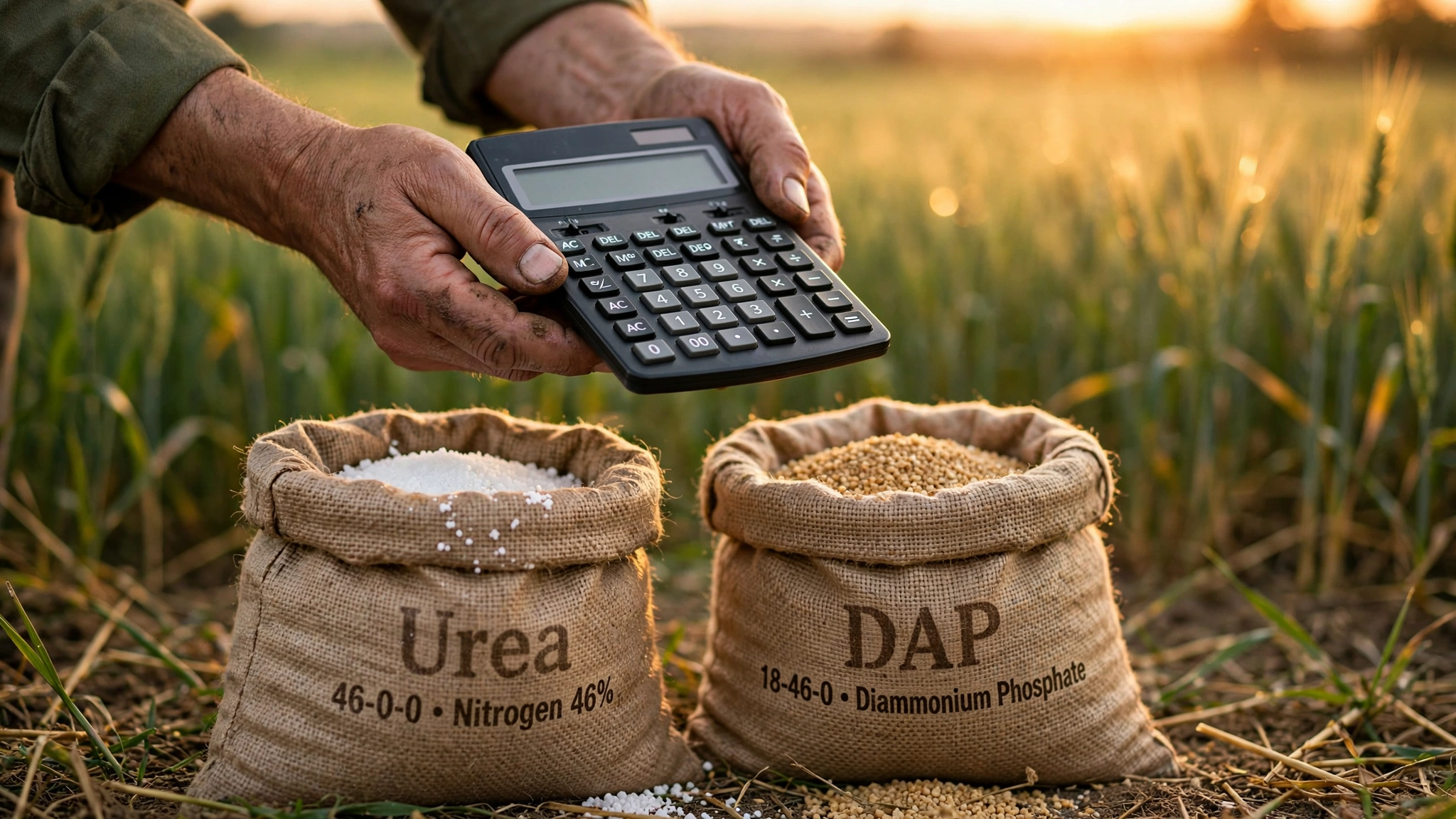
How much urea and DAP does one acre of wheat actually need? The reliable way is five steps: get a nutrient recommendation, check whether it is per hectare or per acre, convert the units, calculate each fertilizer with the standard formula, and split the dose across growth stages. Followed carefully, this turns any recommendation into an exact shopping list — for example, a 120-60-40 (illustrative) recommendation works out to about 1.7 bags of urea and 1 bag of DAP per acre.
Steps 1 to 3: recommendation and units
Step 1 — Get a recommendation you trust. Everything starts with a nutrient target, written like 120-60-40 (kg of N–P₂O₅–K₂O). The best source is a soil test from your district soil laboratory — it tells you what your specific field needs. The next best is your provincial agriculture department's package of practices for the crop — Fertilizer Dose's calculator stores the verified, source-linked version of these recommendations for each crop and region, so check yours there. Never use a neighbour's dose as your recommendation — his soil is not yours. The worked example below uses the round figures 120-60-40 purely to show the arithmetic — they are illustrative, not a real recommendation for any crop. Always substitute your own verified figures.
Step 2 — Check the unit: per hectare or per acre? Recommendations are usually published per hectare, but most Pakistani and Indian farmers think per acre. Mixing these up is the single most expensive mistake in fertilizer math: applying a per-hectare dose to every acre overdoses the field by about two and a half times. Before calculating anything, confirm which unit your recommendation uses.
Step 3 — Convert to your unit. To go from per-hectare to per-acre, divide by 2.471. Our example: 120 ÷ 2.471 = 48.6 kg N per acre; 60 ÷ 2.471 = 24.3 kg P₂O₅ per acre; 40 ÷ 2.471 = 16.2 kg K₂O per acre. Other useful conversions: 1 acre = 4 kanal = 80 marla in Pakistan, so divide the per-acre figure by 4 for a kanal and by 80 for a marla; 1 hectare = 10,000 square metres; multiply acres by 0.4047 to get hectares. In India the acre is standard; the bigha varies by state, so always convert bigha to acres first using your state's definition.
Step 4: the dose formula
Step 4 — Calculate each fertilizer with the standard formula: kg of fertilizer = (kg of nutrient needed ÷ % of that nutrient in the fertilizer) × 100. Working per acre with our converted figures (48.6 N, 24.3 P₂O₅, 16.2 K₂O): phosphate first with DAP (18-46-0): 24.3 ÷ 46 × 100 = 52.8 kg DAP per acre. Subtract DAP's free nitrogen: 52.8 × 0.18 = 9.5 kg N already supplied, leaving 48.6 − 9.5 = 39.1 kg N. Urea (46-0-0) for the rest: 39.1 ÷ 46 × 100 = 85.0 kg urea per acre. MOP (0-0-60) for potash: 16.2 ÷ 60 × 100 = 27.0 kg MOP per acre. In 50 kg bags: roughly 1 bag of DAP, 1.7 bags of urea and half a bag of MOP per acre. For the full derivation of this formula, see our guide on the NPK fertilizer calculation formula.
Step 5: split the dose
Step 5 — Split the dose across growth stages. Rarely does all fertilizer go down at sowing. The standard practice for cereals like wheat is: all of the phosphate and potash at sowing (mixed into the seedbed), and nitrogen in splits — typically about one-third at sowing and the rest with the first and later irrigations. Splitting nitrogen matches supply to the plant's demand and reduces losses. Your provincial package of practices gives the exact split for each crop; the principle above is the pattern it follows.
Common questions answered
Do I really need a soil test, or can I use the general recommendation? A soil test is always better — it can save you an entire bag of DAP if your phosphorus is already high. But if testing is not available, the provincial department's general recommendation for your crop and region is a sound starting point.
Should the whole dose go at sowing time? No. Put phosphate and potash down at sowing, but split nitrogen across irrigations. Dumping all nitrogen at once wastes much of it and risks lodging.
My field is 2.5 acres — do I just multiply? Yes — fertilizer math scales linearly with area. Multiply the per-acre figures by 2.5. Just make sure your area measurement itself is accurate first.
Bottom line: calculating fertilizer dose per acre is five reliable steps — verified recommendation, unit check, conversion, the per-fertilizer formula, and growth-stage splits. Do it once on paper and you will never guess at the shop again — or skip the arithmetic entirely and let Fertilizer Dose's calculator do it for your crop and region.