
Organic vs Chemical Fertilizer: Honest Pros and Cons
Organic vs chemical fertilizer, honestly compared: chemicals feed the crop fast and precisely, organics build the soil slowly. Most farms need both.
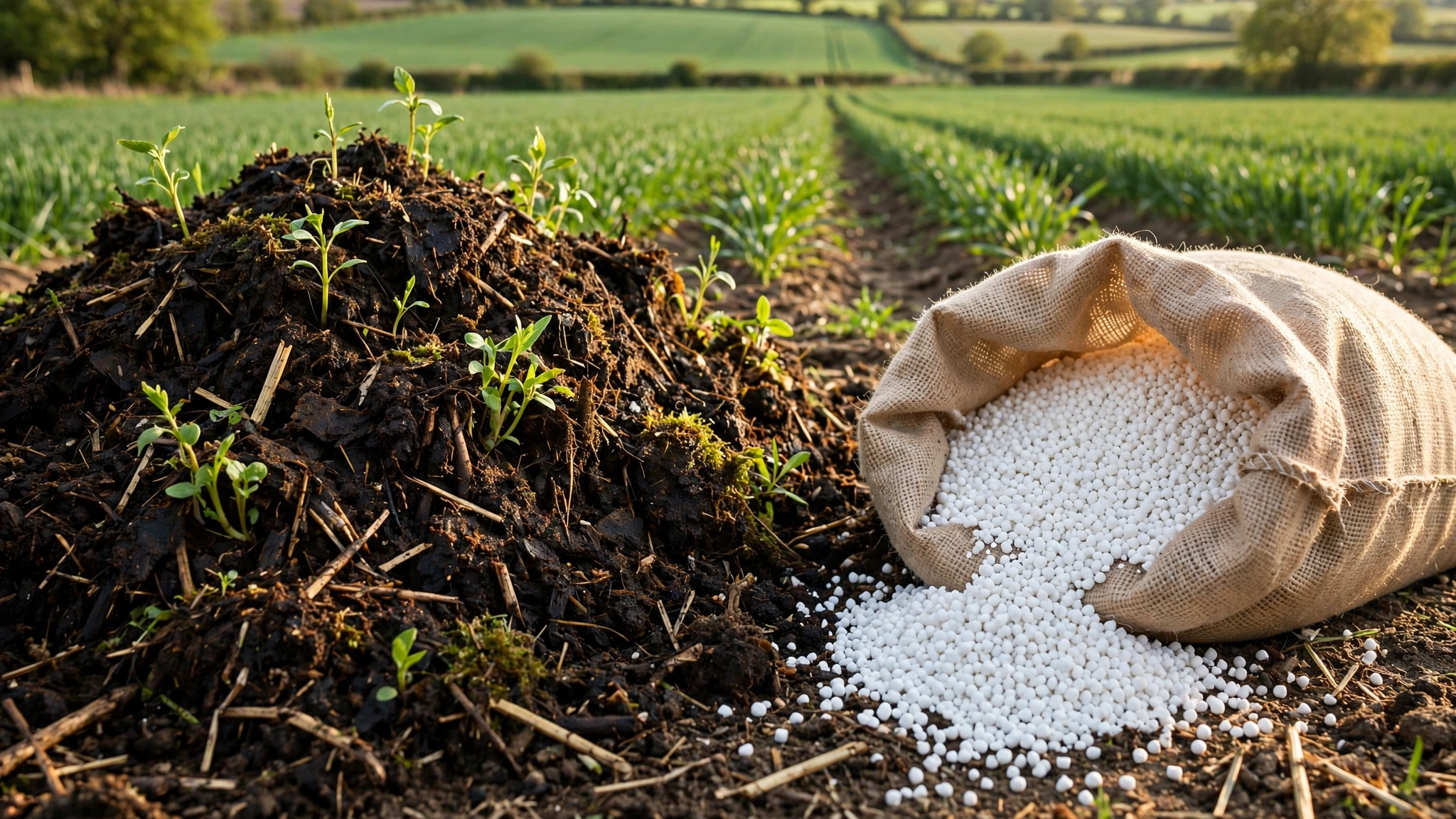
The difference between organic fertilizer and chemical fertilizer is usually framed as a fight, with one side cast as the villain. That framing helps nobody. Chemical fertilizers like urea and DAP supply nutrients in exact, fast-acting forms, while organic sources like farmyard manure and compost supply nutrients slowly along with organic matter. Both have genuine strengths and genuine drawbacks, and most experienced farmers end up using a mix rather than picking a team.
What is the difference between chemical and organic fertilizer?
What is the difference between chemical and organic fertilizer? The core difference is form and speed. Chemical fertilizers supply nutrients as concentrated mineral salts that dissolve and become plant-available within days, with exact, guaranteed analysis on every bag. Organic fertilizers supply nutrients locked inside carbon-rich material that soil microbes must break down first, releasing nutrition slowly over weeks and months, with variable and usually low nutrient content. In short: chemical fertilizer vs organic fertilizer is precision and speed against soil-building and steadiness. The sections below compare them honestly, strength against strength.
Chemical fertilizer strengths
Start with what chemical fertilizers do well. Their biggest advantage is precision. A bag of urea is 46-0-0, every time, so you know exactly how many kilograms of nitrogen you are applying. That precision lets you match a soil-test recommendation almost exactly, which is why our /calculator can turn a nutrient target into an exact bag count. You cannot do that with a tractor-load of manure whose nutrient content varies from load to load.
Speed is the second advantage. Chemical fertilizers dissolve in soil moisture and become plant-available within days. When a wheat crop shows nitrogen deficiency at tillering, a top-dressing of urea corrects it quickly. Organic sources release nutrients over weeks and months as microbes break them down, which is too slow for an in-season rescue.
The third advantage is logistics. Chemical fertilizers are concentrated, so a few bags cover an acre. Organic manures are bulky and dilute. Farmyard manure typically contains well under one percent nitrogen, so supplying the same nitrogen as one bag of urea can take several tonnes of manure, plus the labor to transport and spread it. For a farmer without nearby livestock, that math rarely works.
Chemical fertilizer downsides
Now the honest downsides of chemical fertilizers. The biggest is that they feed the plant but not the soil. Years of applying only urea and DAP, with all crop residue removed or burned, gradually depletes soil organic matter. Organic matter is what holds soil structure together, retains moisture, and supports the microbial life that cycles nutrients naturally. A soil treated only with chemicals for decades often becomes harder, less absorbent, and more dependent on ever-larger fertilizer doses.
The second downside is the margin for error. Because chemical fertilizers are concentrated salts, over-application causes fertilizer burn, nutrient imbalances, and wasted money much faster than organic sources do. Applying double the needed DAP does not double your yield; the excess phosphorus mostly locks up in the soil, and the extra nitrogen can leach away or damage seedlings.
The third downside is price exposure. Chemical fertilizer prices swing with energy and global markets, and when prices spike, farmers who depend entirely on bagged fertilizer feel it immediately. Organic sources produced on the farm, like manure and compost, are insulated from those swings, though they carry their own labor cost.
Organic fertilizer strengths
Turn now to organic fertilizers, and give them the same honest treatment. Their standout strength is soil building. Manure, compost, and green manures add organic matter, improve soil structure, increase water retention, and feed beneficial microbes. A soil rich in organic matter holds onto chemical fertilizer nutrients better too, so organics make your bagged fertilizer work more efficiently.
Their second strength is the slow, steady release of nutrients, including secondary nutrients and micronutrients that straight chemical fertilizers often lack. Manure supplies small amounts of zinc, iron, and boron alongside the big three nutrients. These extras rarely make the label, but over years they help prevent the hidden micronutrient deficiencies that quietly cap yields.
The third strength is cost and availability for livestock-owning households. If you already keep cattle, manure is essentially free apart from labor. Composting crop residue costs nothing but time and turns a waste problem into a resource.
Organic fertilizer drawbacks
The drawbacks of organics are equally real. First, the nutrient content is low and unpredictable. One batch of farmyard manure might have noticeably more nitrogen than the next, depending on the animals, feed, bedding, and how long it sat in the heap. You cannot plan a precise dose from it, which is why agronomists treat manure as a soil conditioner first and a nutrient source second.
Second, the release is slow. Fresh manure applied just before sowing will not feed the young crop in its first critical weeks. Poorly decomposed manure can even temporarily tie up soil nitrogen as microbes consume it to break down the carbon-rich material, a process that can starve seedlings of nitrogen for a short period. Well-rotted, composted manure avoids this problem, which is why composting matters.
Third, bulk and handling. Moving tonnes of manure per acre takes real labor and transport, and raw manure can carry weed seeds and pathogens if it has not been properly composted. Hot composting, where the heap genuinely heats up, kills most weed seeds and pathogens, but a cold, neglected heap does not.
Use both: integrated nutrient management
So how should a farmer actually decide? The practical answer used by most agronomists is integrated nutrient management: use soil-test-based chemical fertilizer for precision and timing, and add organic matter every year for soil health. For example, apply well-rotted manure or compost before sowing to build the soil, then use the /calculator to work out the exact urea, DAP, and MOP dose your crop still needs on top of it.
A few practical rules make the combination work. Compost manure before applying so nutrients release predictably and weed seeds die. Do not count manure as a full replacement for phosphorus and potassium unless you have lab analysis of that specific batch. Keep applying chemical fertilizer by the soil test, not by habit, and watch the field: darker, crumblier soil and better moisture retention over a few seasons are the signs your organic additions are paying off.
The common mistakes on both sides are mirror images. Chemical-only farmers often skip soil testing and apply the same bags every year out of habit, slowly acidifying or salting their soil. Organic-only enthusiasts sometimes assume manure alone can meet a high-yielding crop's full nutrient demand, then wonder why yields plateau. Both mistakes come from treating one approach as a belief rather than a tool.
In short, chemical fertilizers are precise, fast, and concentrated but do nothing for soil structure and punish over-application. Organic fertilizers build soil and supply a broad spectrum of nutrients but are dilute, variable, and slow. Use chemicals for what the crop needs this season, use organics for what the soil needs every season, and let a soil test referee between them. Our /faq answers the practical questions that come up along the way, and the /planting-calendar helps you time every application to the crop's actual growth stages.