
Phosphorus Deficiency in Rice: Symptoms and How to Correct It
Stunted plants with dark, bluish-green leaves and purple discoloration are the classic phosphorus deficiency symptoms in rice. Because phosphorus barely moves in soil, placement and timing matter more than the product you choose.
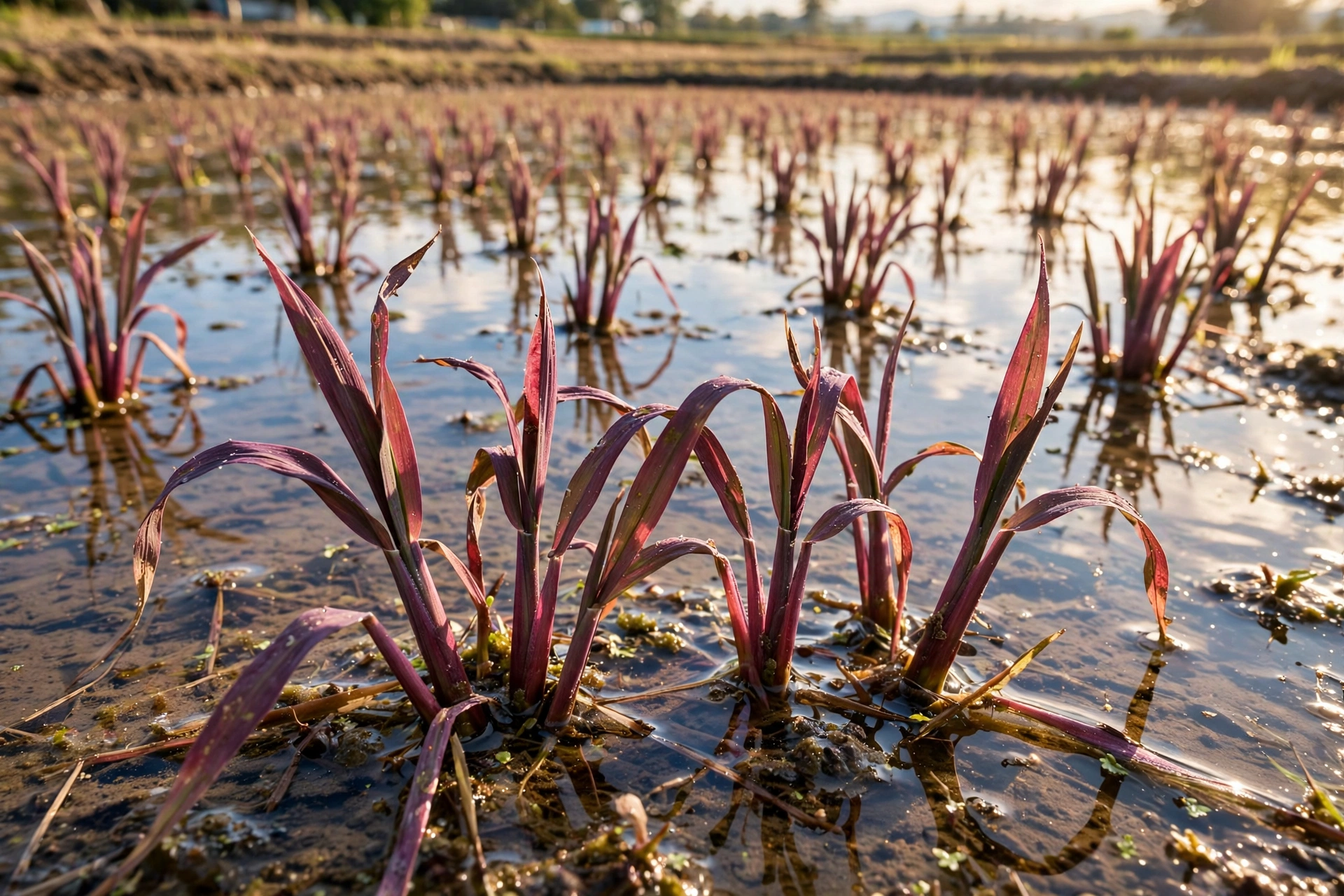
Phosphorus deficiency in rice shows up as a distinctive combination: plants stay short and stunted, leaves take on an unusually dark, bluish-green color, and a reddish-purple discoloration spreads across the leaf blades and sheaths. Tillering drops off sharply, and the whole crop looks like it stopped growing weeks ago while the calendar kept moving. If your rice is short, dark, and purpling instead of tall and green, phosphorus is the first suspect.
Why rice turns purple and dark
The purple color is the plant's stress response, not a disease. When phosphorus is scarce, the plant cannot move sugars out of the leaves efficiently, and it responds by producing reddish-purple pigments called anthocyanins in the leaf tissue. This purpling typically appears first on the older, lower leaves and on the leaf sheaths near the base of the plant, and in young seedlings it can be strikingly visible. A healthy rice leaf is a bright, fresh green; a phosphorus-starved one is dark, dull, and tinged with purple.
Unlike the yellowing of nitrogen deficiency, phosphorus-deficient rice rarely looks pale. The dark green color can actually mislead farmers into thinking the crop has plenty of nutrition, when the opposite is true — the darkness comes from stunted cells packed with chlorophyll, not from vigorous growth. The real giveaway is the growth itself: short plants, thin stems, few tillers, and slow development. Roots are often poorly developed too, which you can confirm by pulling up a plant and comparing its root mass with a healthy one from a good patch of the same field.
Because phosphorus is mobile inside the plant, deficiency symptoms generally appear on older leaves first as the plant moves its limited supply to new growth — though in rice the purpling is often most obvious on young, actively stressed plants. Delayed maturity is another classic sign: phosphorus-starved rice heads late and ripens unevenly, because the energy-transfer processes that phosphorus drives are running at half speed through the entire season.
Lock-up: why the soil holds back
The underlying cause is usually not that the soil contains no phosphorus, but that the plant cannot reach it. In acidic soils, phosphorus gets locked up with iron and aluminum into forms roots cannot absorb; in strongly alkaline soils, it binds with calcium with the same result. Cold weather early in the season slows root activity and phosphorus uptake, which is why deficiency symptoms often appear in young transplanted rice and then ease as the weather warms. Low organic matter, eroded topsoil, and fertilizer placed far from the root zone all make the problem worse.
This lock-up behavior explains the single most important fact about phosphorus management: phosphorus barely moves in soil. A granule of DAP or single super phosphate dissolves, and the phosphorus is quickly held by soil particles within a centimeter or two of where it landed. Broadcasting phosphorus on the surface of a flooded paddy, far from the roots, is far less effective than placing it in or near the root zone at transplanting. With phosphorus, placement is the dose.
Correcting deficiency starts at transplanting
Correcting a deficiency starts with getting phosphate fertilizer into the root zone as early as possible. The standard practice across rice-growing regions is to apply the full phosphorus dose as a basal application — at or before transplanting, incorporated into the soil where young roots will find it — using DAP or single super phosphate according to local recommendations. Because phosphorus does not move to the roots on its own, topdressing phosphorus later in the season is inefficient; the correction has to happen at the start, which makes early diagnosis valuable.
If you only notice the symptoms mid-season, be honest about what correction can achieve. Adding phosphorus late will not undo stunting that has already happened, because the tillering window is closed. A late application can still help grain development to some degree, but the return is much smaller than the same fertilizer applied at transplanting. This is why prevention — soil testing and a proper basal dose — is worth far more than rescue with phosphorus.
Foliar feeding deserves a clear word of caution. Spraying a dilute phosphate solution on the leaves can green up the crop temporarily and is sometimes used as an emergency measure, but leaves can only absorb tiny amounts compared with what the roots need for the whole season. Foliar sprays cannot substitute for soil-applied phosphorus in rice; at best they buy a little time while you fix the real problem, which is supply in the root zone.
Do not over-apply as insurance
Resist the urge to over-apply as insurance. Excess phosphorus does not make rice grow faster once the requirement is met, and it costs money for no return. Very high phosphorus applications can also interfere with the uptake of zinc and iron, which are already tricky nutrients in flooded rice soils — trading one deficiency for another is a poor bargain. A soil test tells you whether your field is low, medium, or high in available phosphorus, and the dose should match that result, not your anxiety.
Prevention before the next transplanting
Prevention is straightforward and mostly happens before transplanting. Test the soil so you know the starting phosphorus level. In acidic soils, liming according to the test report improves phosphorus availability by reducing iron and aluminum lock-up. Maintaining organic matter through crop residue or farmyard manure helps keep phosphorus in plant-available forms. And placing the basal phosphate dose in the root zone at transplanting — rather than broadcasting it on the surface or skipping it because nitrogen gets all the attention — closes the loop.
Water management plays a supporting role. In flooded paddies, phosphorus availability generally improves after submergence as the soil chemistry shifts, but prolonged deep flooding or poor drainage brings its own problems. Keeping the field level so that water depth is uniform helps the basal phosphorus work evenly across the plot instead of feeding only the low spots. Small details of field leveling and water control often matter more for phosphorus efficiency than the brand of fertilizer.
Keep notes on what you observe. Phosphorus deficiency tends to recur in the same fields and the same patches year after year, because the underlying cause — acidic soil, eroded topsoil, or a history of skipped basal doses — does not fix itself. A field that purples every season at the seedling stage is telling you something specific, and a soil test will usually confirm it. Treat the cause once, properly, and the symptom stops appearing.
To plan the correction with real numbers, open the dose calculator at /calculator and work out your phosphate requirement per acre or per hectare from the crop and area you enter. The verified recommendations under /crops list region-specific NPK doses with their sources, /fertilizers explains how DAP and other phosphate products behave in soil, and the /planting-calendar helps you time transplanting and basal application together. With phosphorus, the lesson of this article is simple: put the right amount in the root zone at the start, and the crop will do the rest.