How to Read a Fertilizer Bag Label: NPK Numbers Explained
Learn how to read a fertilizer bag label: the three NPK numbers tell you exactly how much nitrogen, phosphorus, and potassium each bag holds.
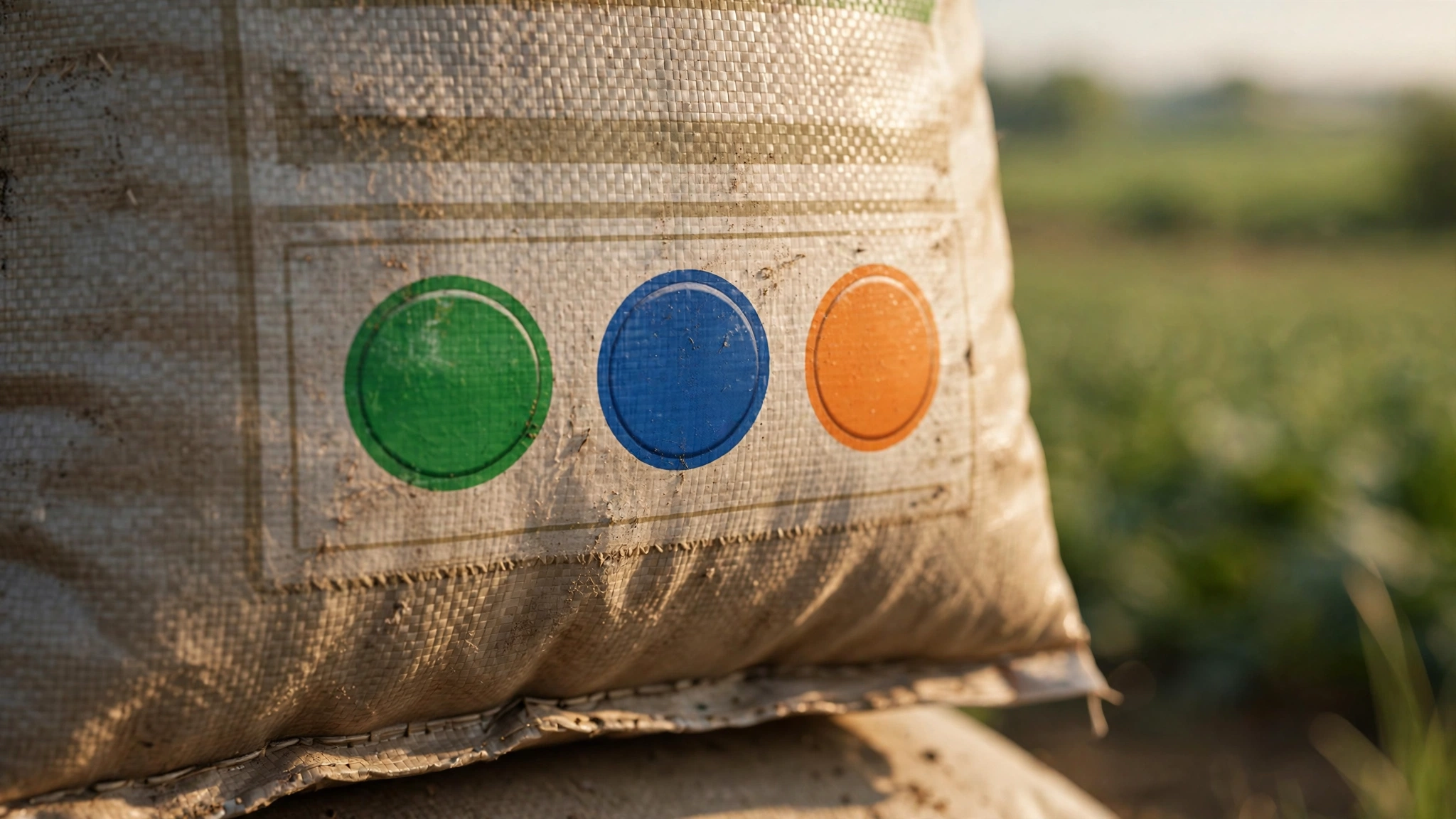
If you want to know how to read a fertilizer bag label, start with the three big numbers printed on the front, like 18-46-0 or 46-0-0. Those three numbers always stand for nitrogen (N), phosphorus (P), and potassium (K) in that exact order, and they tell you what percentage of the bag's weight is each nutrient. So a bag of urea labeled 46-0-0 contains 46 percent nitrogen, no phosphorus, and no potassium.
What the three numbers mean
That percentage is by weight, and this is the single most useful fact on the whole bag. A 50 kilogram bag of urea at 46 percent nitrogen holds 23 kilograms of actual nitrogen, because 50 multiplied by 0.46 equals 23. The rest of the bag is carrier material and coating that helps the granules store well and spread evenly. Once you understand this one idea, you can convert any bag into real nutrient numbers in your head.
The order N-P-K never changes, no matter which company makes the bag. The first number is always nitrogen, shown as total N. The second is phosphorus, but note that it is expressed as phosphate, written P2O5, not elemental phosphorus. The third is potassium, expressed as potash, written K2O. This convention is the same worldwide, which is why a bag in Pakistan, India, or Brazil reads the same way.
A zero on the label is just as informative as a big number. When you see 18-46-0 on DAP, the zero tells you there is no potassium in it at all. When you see 0-0-60 on MOP, the two zeros tell you it supplies only potassium. Straight fertilizers like these carry one or two nutrients, while compound fertilizers like 19-19-19 carry all three in equal shares. Neither type is better in general; they simply solve different problems.
Chemical form, weight, and the dose formula
Beyond the three big numbers, the label usually lists the nutrient in chemical form. Urea bags say the nitrogen is in amide form, DAP says ammoniacal nitrogen plus water-soluble phosphate, and MOP says the potassium comes as potassium chloride. This matters because it tells you how fast the nutrient becomes available and whether there are side effects, like the chloride in MOP, which some chloride-sensitive crops dislike in large amounts.
The label also carries the net weight, almost always 50 kilograms for granular fertilizers in South Asia. Do not confuse bag weight with nutrient weight. A recommendation that says apply 120 kilograms of nitrogen per hectare does not mean four bags of urea. Because urea is 46 percent nitrogen, you divide 120 by 0.46, which gives about 261 kilograms of urea, or just over five 50 kilogram bags per hectare.
That division is the core dose formula and it works for every fertilizer: fertilizer in kilograms equals the nutrient needed multiplied by 100, divided by the nutrient percentage on the label. Say your soil test calls for 60 kilograms of phosphate per hectare and you are using DAP at 18-46-0. Multiply 60 by 100 to get 6000, divide by 46, and you get about 130 kilograms of DAP per hectare, which is roughly two and a half bags. As a bonus, that DAP also gives you nitrogen, since 130 kilograms times 18 percent equals about 23 kilograms of nitrogen, so you subtract that from your planned urea dose later.
Reading the fine print
Our /calculator page runs exactly this math for you, but reading the label yourself is still worth it, because it is how you check that the shopkeeper handed you the right bag. Fake or mislabeled fertilizer is a real problem in many markets, and a bag whose print is blurry, whose grade does not match any standard product, or whose weight feels off deserves a second look before you pay.
The fine print on the bag usually includes storage and handling guidance, and it is worth reading once. Most granular fertilizers absorb moisture from the air, which is why bags say to store in a cool dry place and to reseal opened bags. Lumpy, damp urea still contains nitrogen, but it spreads unevenly through a broadcast spreader, so some rows get too much and some get too little.
Another useful line on many labels is the application guidance or the crop it is registered for. This is general advice, not a prescription for your field. Your actual dose should come from a soil test or a published recommendation for your crop and region, which is what our /fertilizers pages list for each product, including typical nutrient content and common uses.
Common label mistakes
A common mistake is assuming bigger numbers mean a stronger or better fertilizer. A 19-19-19 bag is not stronger than urea; it is simply balanced. If your soil already has plenty of potassium, paying for the potassium in a balanced grade is wasted money. The cheapest bag is the one whose nutrients match what your soil test says you actually lack.
Another frequent error is adding up the three numbers and thinking the total should be 100. It never will be, because the numbers are percentages of three different nutrient forms measured on different scales, and the rest is carrier. A 10-26-26 bag contains 62 percent named nutrients and 38 percent other material, and that is completely normal.
Farmers sometimes also misread liquid fertilizer labels, where the numbers may be given by volume rather than weight, with a density figure printed nearby. If the bag or bottle gives density, multiply the percentage by the density to get nutrient per litre. The N-P-K order rule stays the same, so your reading skill transfers directly.
The two-minute routine
So the two-minute routine is this: read the three numbers left to right as N, P, K; multiply each by the bag weight to get actual nutrient kilograms; and use the dose formula to turn a nutrient recommendation into bags per acre or per hectare. Do that, and the label stops being decoration and becomes a tool.
To put it into practice, open our /calculator, pick your crop, and enter your land area. The calculator shows the full working, from nutrient need to bags of each fertilizer, using the same formula you just learned. Pair it with the product details on /fertilizers and the common questions on /faq, and you will buy and apply fertilizer with complete confidence.